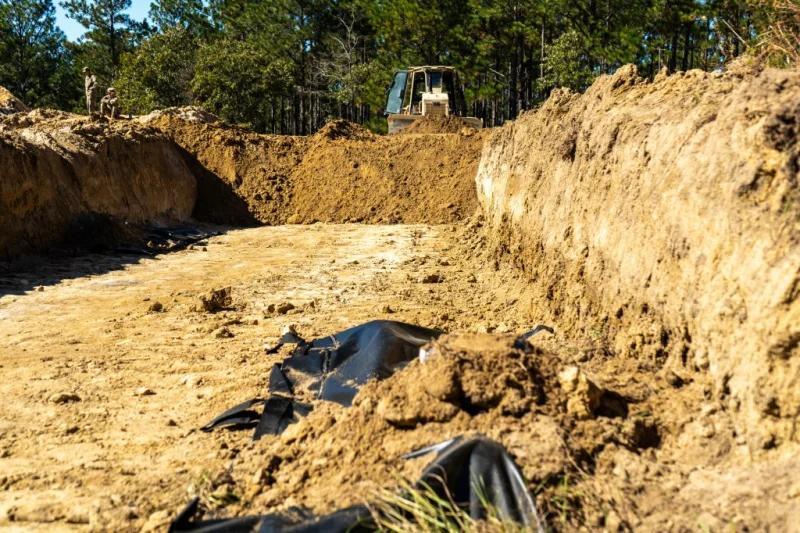
The U.S. Army tested temporary battlefield burial operations in North Carolina, a dry run for what commanders might face if a future war leaves no time to move the dead off the field. During Phase II of Operation Dragon Covenant, soldiers checked whether they could preserve remains for later identification and return to families under combat conditions.
The timing matters because the Army is planning for a kind of war it has not had to manage in decades. Temporary interment on a large scale was last used during the Korean War, and for more than twenty years in Iraq and Afghanistan, air superiority helped move remains quickly through mortuary channels back to the United States. This time, engineers, preventative medicine teams, chaplains and fatality management specialists were all involved, because the Army is trying to answer a grim practical question before a crisis forces the issue.
The exercise gave that question hard numbers. Army doctrine calls for temporary interment plots made up of five parallel trenches that can hold 100 bodies, but earlier trials with standard backhoes managed only one trench and 10 remains in three hours. In the latest test, operators using D6 bulldozers dug a trench for 20 remains in an average of one hour and 15 minutes, and the service said commanders could plan for an engineer company with the right equipment to dig and cover trenches for up to 2,400 bodies every 24 hours if it worked nonstop.

Delbert Ruede said the drill was meant to force a serious look at how the Army would care for its dead in a high-intensity conflict. He said that if the Army went to war tomorrow, it would be making burial procedures up as it went along, and that the exercise was meant to replace improvisation with a scientific, field-tested approach that keeps positive control of the fallen.
The exercise also exposed a problem inside the system it was meant to test. Army guidance said trenches should be spaced seven feet apart, but that distance proved too narrow to drive a dozer between them without disturbing the burial plots. The Army said current instructions exist, yet the field results showed that published trench standards did not match current equipment.
That gap is what makes the drill more than a paper exercise. U.S. rules require remains to be evacuated when wartime conditions allow, and joint guidance allows temporary graves only when bodies cannot be safely moved because of danger, a lack of transportation, or chemical, biological, radiological or nuclear weapons. The Geneva Conventions also require enemy dead to be recorded and identified when possible, which means the details gathered here are meant to shape how the Army handles not just burial, but later recovery, documentation and repatriation. The service said the findings, including the trench-spacing issue, will be reflected in future Army doctrine, but it gave no date for that change.