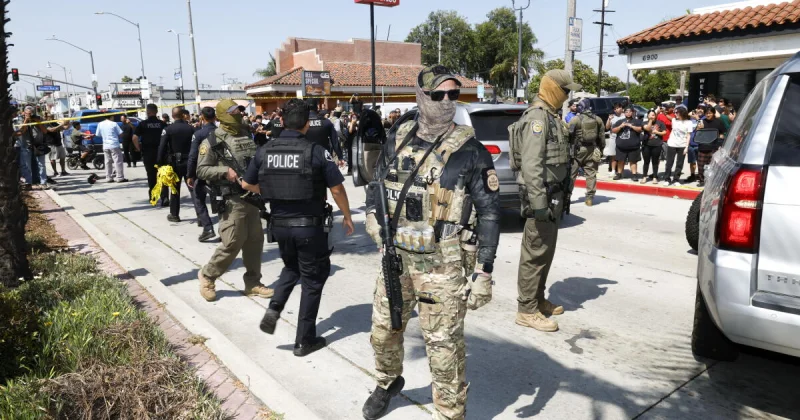
U.S. District Judge Maame Ewusi-Mensah Frimpong has ordered immigration agents in Southern California to stop using racial stereotypes as the basis for stops, handing down a preliminary injunction that took effect last week and was made public Thursday. The order requires agents to have individualized reasonable suspicion before detaining someone for immigration enforcement, and it reaches a region where immigration policing touches millions of people.
That is why the ruling is being searched now: the Trump administration filed a notice of appeal on Wednesday, sending the fight to the 9th Circuit Court of Appeals while the injunction remains in place. For now, agents are barred from making stops on the theory that someone appears Latino or looks Latino and working class, except at ports of entry, checkpoints and other functional equivalents of the border.
The evidence behind the order was not thin. Frimpong cited a mountain of proof from the plaintiffs, including body-camera footage and text messages in which immigration agents referred to Latinos with slurs such as tonk and wet. She concluded that the plaintiffs were likely to show the practice violated the 4th Amendment and the 5th Amendment, and that appearing to be Latino and working class is not enough to justify a stop.

She also rejected the government’s claim that training alone solves the problem. In her view, the government’s showing that it trains agents to follow the law could not overcome evidence that, in practice, the law was not being followed. Her order did not amount to a final ruling that the government maintained an unlawful policy, but it did say the plaintiffs were likely to prove there was a policy in the Los Angeles area of stopping people for immigration purposes because they look Latino or because they look Latino and working class.
Mohammad Tajsar, speaking for the plaintiffs, said the case showed that Latino community members in Southern California were being racially profiled on a sweeping scale and said his side would closely monitor compliance with the injunction. The judge also ordered immigration agents to stop making civil arrests without a warrant unless they first determine that a person is likely to escape before one can be obtained, adding another layer of restraint while the appeal is pending.
The clash now shifts to whether the 9th Circuit will let the order stand while the case moves forward. August Flentje, for the government, said the injunction gravely hinders immigration stops and would inflict irreparable harm on multiple federal agencies and the public interest, while the plaintiffs say the ruling is only forcing agents to meet the constitutional threshold that should have governed these stops from the start.