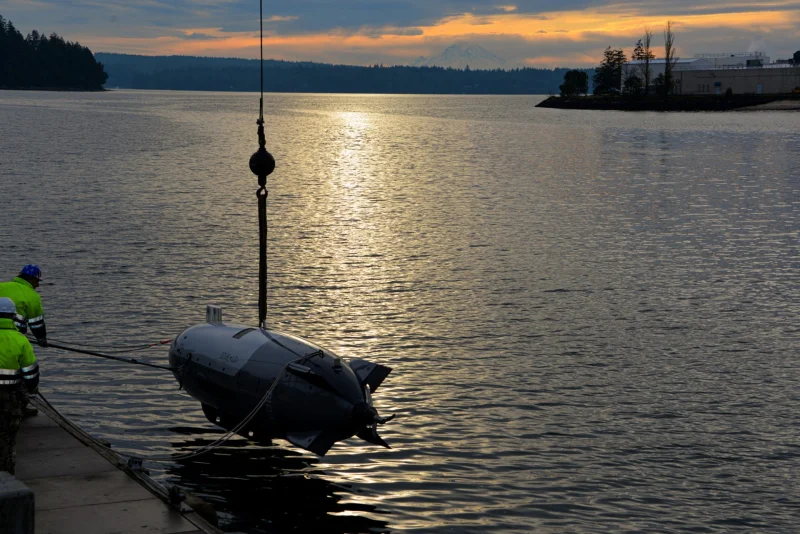
The US military said an unmanned submarine in the Strait of Hormuz had already malfunctioned more than a day before Iran said its forces seized it at dawn. Iran’s Islamic Revolutionary Guard Corps described the episode as a complex intelligence and operational action, but US Central Command said the vessel was a defective older model.
That denial matters because the Strait of Hormuz normally carries about one fifth of the world’s oil and gas shipments, and the claim landed after a month of relative calm in August gave way to renewed Iran and US exchanges of fire. The waterway has been under an Iranian blockade for more than six months, while the US has imposed its own blockade of Iranian ports.

US Navy Capt Tim Hawkins said the submersible did not carry classified sonar or radar equipment and was not collecting sensitive data. His account is the sharpest reason the incident has become more than a routine maritime dispute: if the vessel was already dead in the water before the IRGC reached it, then the seizure claim and the US account describe two very different events.
That split sits beside a wider military exchange that is still unfolding. On Tuesday, Centcom said a warship evaded two attempted ballistic missile attacks by the IRGC, with no American personnel injured, and US forces struck Iranian tankers in the Gulf of Oman and near Kharg Island after directing the crews to abandon ship.
Marco Rubio said Iran continues to try to hit US naval ships and warned that for every such move, tanker losses would follow. He added that readers would likely see that again today. What remains unresolved is the simplest question in the case: whether Iran physically recovered an unmanned submarine that had already failed, or whether it only reached a vessel the US says had stopped working long before the seizure claim.