A new study in Science says the next Ice Age may have already begun about 2,000 years ago, only to be cut short by human-driven climate change. The finding turns a deep-time climate question into a present-day one: human warming may have interrupted a natural shift toward colder conditions before it could take hold.
Nicolás Young, who helped lead the work, said the next glaciation was about to happen and then stopped. That matters because the study is not talking about a distant hypothetical. It argues that Earth’s long climate cycle was already moving toward its next cold phase, and that the modern warming trend may have pushed back against it at the critical moment.
To get there, researchers focused on the Laurentide Ice Sheet, the giant mass that covered much of the northern US and Canada from around 95,000 to 20,000 years ago. At its maximum, it reached from the Arctic Circle to Illinois, with ice up to 3 kilometers thick and a total volume that may have been equal to about 80 meters of sea-level shift. That scale matters because the study uses the old ice sheet as a clock for how Earth’s climate changed as the last great glaciation ended.

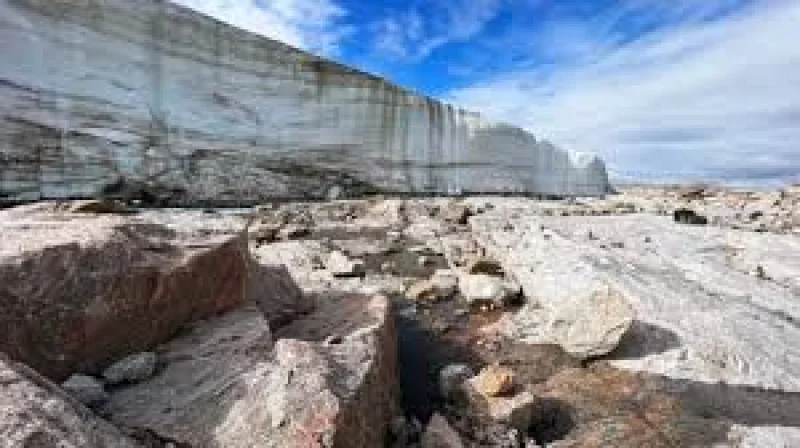
The team built an ice cap chronology using atomic dating methods. They measured cosmogenic beryllium-10 in rocks and analyzed carbon-14 in long-dead vegetation exposed as the Barnes Ice Cap retreated. Those dates let the researchers reconstruct when ice was pulling back and when conditions in the north had become favorable for a new advance. The study says the highest temperatures of the Holocene may have come around 11,000 to 10,000 years ago in northerly climates, tied to high solar irradiation from Milankovitch cycles.
That chronology is what makes the paper provocative. If the pattern is read the way the researchers interpret it, the next glaciation was already on the calendar by about 2,000 years ago, even though Earth is still in a geological ice age and now sits in a warmer interglacial period that began around 11,700 years ago. In other words, the planet may have been heading toward a fresh ice advance when human-driven warming changed the direction of travel.
The unanswered question is not whether the climate system has changed, but how much warming was enough to stop it. The study does not put a number on that threshold, and it does not say the next glaciation is gone forever. What it does say is sharper: the natural transition may already have started, and human activity may have been strong enough to interrupt it.