


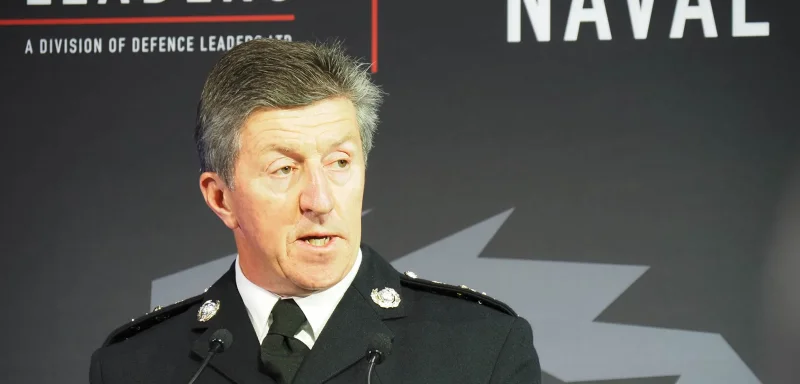
The Royal Navy must move away from the need for “ever bigger, ever more expensive platforms,” First Sea Lord General Gwyn Jenkins said on Tuesday, setting out the clearest public case yet for a fleet built around crewed and uncrewed assets. Speaking at the 2026 Combined Naval Event in Farnborough, Jenkins said the service should be “crewed where necessary, uncrewed wherever possible, integrated always.”
His message landed with unusual force because he attached it to money already in play and to a real deployment now under way. Jenkins said £115 million has already been made available for the hybrid navy programme, and said the Gulf deployment is its first major test. The package includes autonomous minehunting equipment, mine clearance specialists and extra capabilities for HMS Dragon, which is currently deployed to the Gulf region, along with Project BEEHIVE as a base of operations.
Jenkins argued that the Royal Navy’s task is not to pour shrinking resources into a handful of high-value hulls, but to generate mass and lethality from a wider, more survivable mix of assets. He said resources will always be constrained, and that autonomy is already changing the nature of warfare, pointing to Ukraine and the Middle East as proof.
“I accept that there are still some hybrid sceptics, but here’s the hard news: we have no time to pander to cynicism or traditionalists, because autonomy is already demonstrably changing the nature of warfare, as evidenced in Ukraine and in the Middle East,” he said.
That approach already reaches into some of the Navy’s biggest future programmes. ATLANTIC SHEILD is designed to spread integrated air and missile defence across a layered network of crewed and uncrewed assets, with the Future Air Defence System intended to form its core. The Type 83 destroyer is intended to form the core of that air defence programme, while the Multi-Role Strike Ship will face similar questions. ATLANTIC STRIKE is meant to strengthen conventional deterrence and reach through a mix of crewed and autonomous platforms.
The speech also carried a pointed message for those waiting on the defence investment plan, which has been delayed and has frustrated industry. Jenkins told the audience: “I know many of you are waiting for the defence investment plan. Trust me, when I say we’re not alone, but I want to reassure you that this is not holding us back.”
That is the tension running through the Royal Navy’s push to become a hybrid force. The service has been moving toward a model built around crewed and uncrewed assets, but the details still have to be squared with major shipbuilding choices and the wider spending plan. Earlier wargame analysis suggested a threefold increase in missile capacity under the hybrid model, though with the usual caveats.
For now, the Gulf will show whether that idea works outside the briefing room. If the mix of autonomous systems, specialist teams and existing ships delivers what Jenkins says it can, the Navy’s next big platforms will be designed in a very different argument from the one that shaped the last generation.
