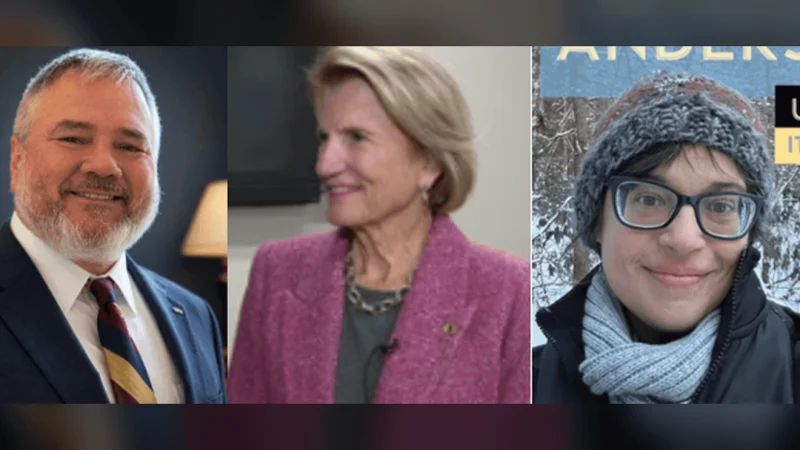
Shelley Moore Capito spent the final full day before Election Day making one last case to undecided voters, while Rachel Fetty Anderson headed back into southern West Virginia to keep knocking on doors. The two candidates were chasing the same narrow window of attention as the polls prepared to open for the midterms.
Capito joined Republican candidates for state legislative seats and local offices in Kanawha County on Monday evening for a rally at Elk City Pizza on Charleston's West Side, where she told supporters, “The most important thing is to get out vote.” She also cast the race as part of a broader effort to build a conservative bench, saying Republicans needed “good solid conservatives” in the statehouse, county commissions, city councils and the United States Senate.
For Capito, the stop was part of a familiar closing argument. She is seeking a third six-year term after nearly 26 years in Congress, first winning a seat in the U.S. House of Representatives in 2001 before moving to the Senate in 2015, when she succeeded Jay Rockefeller. She was re-elected in 2020 and has since climbed in Senate GOP leadership, beginning 2025 as the 18th chairperson of the Republican Policy Committee and the fourth ranking member in the Senate Republican majority.
She used the rally to lean on a theme of competence and access. Capito said she had served “with integrity and trust,” adding that “people value that.” She said she wanted voters to know that “the heart that I had when I started is the same heart I have now” and described herself as “very easily accessible,” someone who listens and goes to events across the state.

That message was paired with a practical pitch about what voters could get done through her office. Capito said her team was out there “all the time” flagging the effects of legislation and helping with issues such as Corridor H, the WVU dental school, nursing at Concord, a gas line or a water line. She said those were the kinds of things she takes “extremely, seriously” and works hard on, adding that her door is always open.
Anderson, an attorney and former Morgantown City Council member who still sits on the Morgantown Civilian Police Review and Advisory Board, said Monday morning that she was heading to Nicholas County to continue door-knocking in the southern half of West Virginia. She said she had focused on getting in front of real West Virginians and not turning anyone away, and she said she was “feeling pretty optimistic.”
Her closing pitch pushed in the opposite direction from Capito’s. Anderson said voters had made “real strides in educating the public” about the right to be represented in a way that is open and transparent and that gives them access to the candidate or elected official “without a lot of barriers or without arresting them.” That was a direct reference to the protests that led to arrests at Capito’s Charleston offices last year, a reminder that the campaign’s final stretch was being shaped as much by questions of access as by party labels.
By Monday night, both campaigns were down to the same calculation: persuading a small slice of voters before the ballots were cast. What mattered next was not another rally or another round of door-knocking, but whether Capito’s case for experience and accessibility or Anderson’s argument for openness and accountability would carry farther once Election Day began.