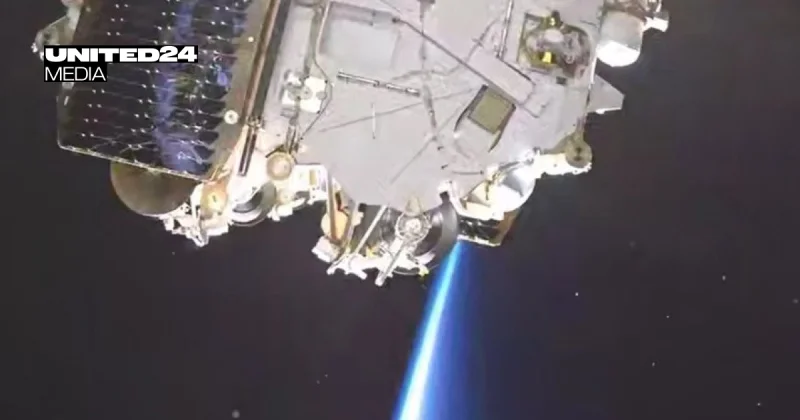
Rassvet-3 satellite No. 17 burned up in Earth’s atmosphere on October 30 after slowly dropping from orbit and never switching on its propulsion system. The spacecraft, NORAD identifier 100083, had been launched on July 19 aboard a Soyuz-2.1b rocket as part of a batch of 16 spacecraft.
The failure is the second time a Rassvet satellite has left orbit without ever activating propulsion or making course corrections. On June 6, Rassvet-3 satellite No. 4, NORAD identifier 68363, fell out of orbit after its March 23 launch in the first batch, showing that the early deployment is running into more than one problem even as Bureau 1440 keeps pushing the constellation forward.
What makes the latest loss stand out is the pace of the decay. Atmospheric drag steadily pulled No. 17 down until it reached a critical level, and after three months and 11 days in orbit the satellite burned up in the dense layers of the atmosphere. Two satellites from the second batch, Nos. 17 and 23, had been at risk of falling out of orbit for some time, which put the focus on whether the system was holding together as intended.

That concern sits beside a more complicated picture. Russia rapidly raised the orbit of satellite No. 23 on October 20 at an altitude of 220 km, and the spacecraft is now at roughly 300 km and still climbing. Of the 30 Rassvet-3 satellites currently in orbit, 26 have already reached 500 km, while another satellite, No. 11, is expected to get there soon. The planned altitude for the Rassvet constellation is 800 km, so the fleet is still well short of its final operating layer.
For now, the satellites are concentrating around 500 km, where they are spreading out relative to one another and moving into their required orbital positions. Once all of them reach that level and take up their designated places, they are meant to begin a synchronized ascent and spread along the full orbital path. The system is already operating there, but still in test mode, with Bureau 1440 carrying out trials and testing communication terminals in remote regions of Russia.
That is why the situation can look both orderly and unsettled at the same time. The deployment is moving slowly, and two satellites have already been lost, yet the constellation is still being described as progressing fairly successfully. The unanswered point is the one that matters most: why No. 17 never activated its propulsion system after reaching orbit, even as the rest of the batch continued the climb toward the constellation’s planned height.