Google says Gemini 4 Argon is now globally available for developers and enterprises through the API in AI Studio and the Gemini platform, while Google AI Ultra and Pro subscribers can also use it in Google Antigravity, the Gemini app and AI Mode in Search. The release puts the company’s newest model into more hands at once, from builders shipping products to paid users looking for more capable help inside Google services.
The timing matters because this is the first broad availability push for a model Google describes as its smartest yet. The company says Gemini 4 Argon was built to solve hard problems, with strengths in reasoning, coding and tool coordination, and it is being pitched for deep comprehension and long-horizon workflows that stretch across research, visuals and code.
Google is backing that claim with demonstrations rather than independently measured benchmarks. In one example, Gemini 4 Argon wrote 5,000 lines of math to render a 3D sunlit library from scratch. In another, it generated a custom audiovisual tool in the Gemini app after being asked to build an app that could overlay shapes across videos. Google also says it was used to prototype complex 3D visualizations, high-fidelity games and interactive animations.
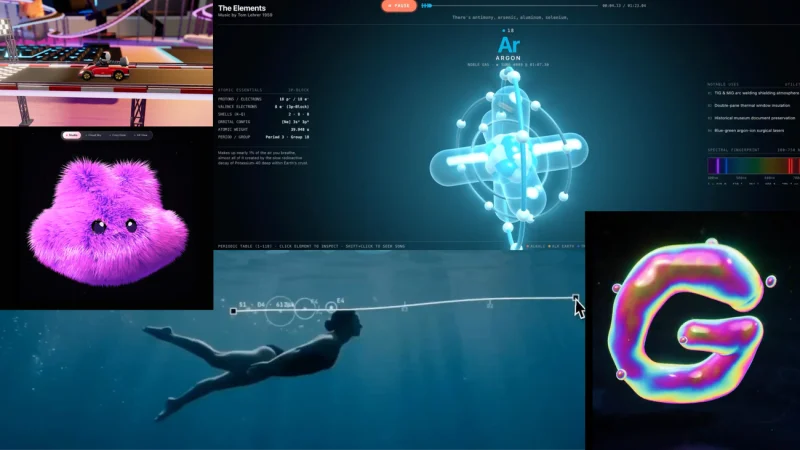
Other examples go further. In Antigravity, Gemini 4 Argon was used to orchestrate subagents, Blender MCP and Nano Banana to turn pictures of a real desk into a playable 3D track. It also generated a self-navigating 3D periodic table with animated atoms and frame-accurate audio timing, and was used to create a custom fur engine with studio-grade hair dynamics and an interactive musical G with fluid physics and reactive sound. Google says the model is especially strong when work requires visual understanding.
The company has also pointed to a more data-heavy task: Gemini 4 Argon was given more than 80,000 raw files from NASA, accumulated across 72 flights on Mars, to parse information, organize insights and turn the material into an executive-ready deck. It also used Nano Banana and Veo to turn scientific concepts in a PDF into an illustrated animation in the Gemini app. Those examples show range, but they still stop short of the kind of public evaluation that would let outside users compare the model cleanly against earlier Gemini versions or rivals.
That gap matters because Google is asking developers and enterprises to treat Gemini 4 Argon as the model for complex work before the public has access to a full independent scorecard. For now, the strongest evidence is what the model can produce in Google’s own demonstrations. What comes next is less about another announcement and more about whether real users can make the same kind of work happen at scale.