A farmer’s chance find on his land in Egypt’s Nile Delta has opened a major new chapter in the search for Ramses II’s remains. Khaled al-Shahat found a pink stone covered in hieroglyphic inscriptions, called the authorities, and archaeologists then uncovered the remains of two colossal statues linked to the ancient ruler.
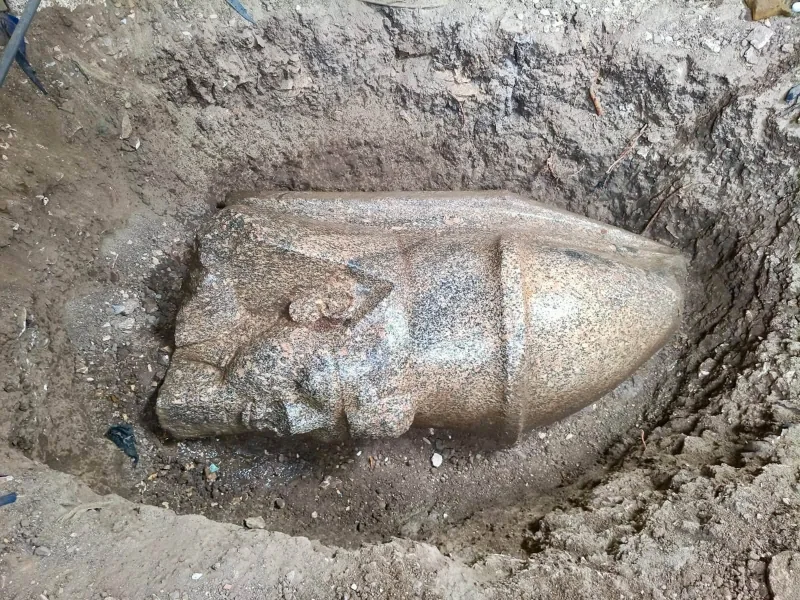
The Egyptian Ministry of Tourism and Antiquities said the first piece to emerge was a five-foot-tall head that once topped a colossal statue of Ramses II. The head shows the pharaoh wearing a double crown, and the upper section of the back pillar carries his formal royal title, Hor Ka Nakht Mery Maat. Officials believe the full statue may have stood nearly 28 feet tall including its base, a scale that makes the discovery hard to mistake for anything ordinary.
What pulled attention to the site was not just the size of the find but the sequence that led to it. Shahat said he was surprised and happy when more antiquities came to light, and he told officials they said the discovery might change the history of the area. His pink granite block was more than four feet long and sat about three feet from a second Ramses II statue fragment, a nearly eight-foot-tall section missing its base and legs. That second figure has a head clad in a nemes, the striped headcloth associated with pharaohs, while the block itself carries traces of hieroglyphic inscriptions including Nesw-Bity and Sa-Ra.

Yet the story is not just about a lucky discovery on private land. The artifacts were found in Behbeit El-Hagar, about 80 miles north of Cairo, on the western side of a temple complex already known for the remains of an ancient sanctuary dedicated to Isis. That temple was built mainly under Nectanebo II and later completed under Ptolemy II and Ptolemy III before collapsing sometime before the early third century C.E., possibly after an earthquake. The find sits inside a place that has been studied before, which is why the new fragments matter as much for what they suggest about the layout of the complex as for what they reveal about Ramses II.
Mahmoud Emam said this was not the first time archaeologists had uncovered objects tied to Ramses II in Behbeit El-Hagar, and that history gives the latest work added weight. The new fragments may help map how the royal statues were arranged on the western side of the site and why they were placed there at all. Archaeologists are still excavating, and the next pieces they recover may be the ones that show whether these two colossal remains once stood together or marked different points in the temple complex.