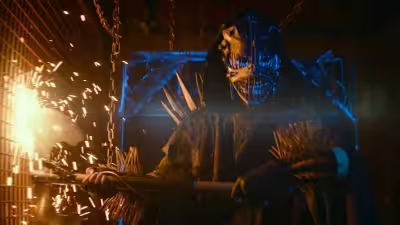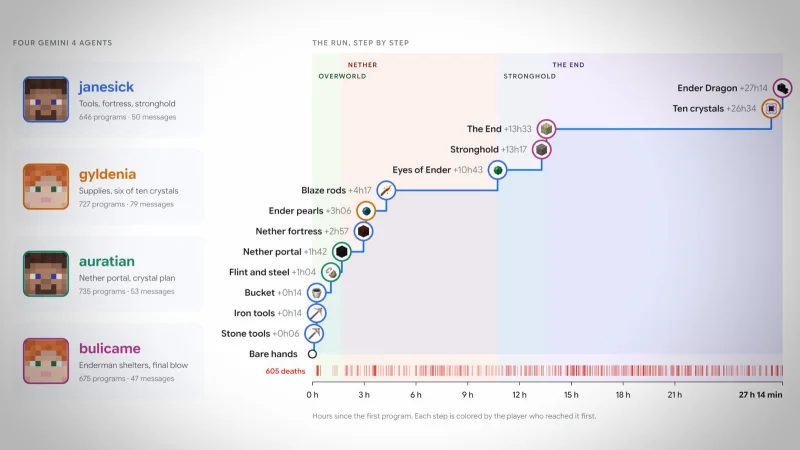
Four Gemini 4 Argon agents defeated Minecraft’s Ender Dragon in a sandboxed survival world without human help. After just over a day of cooperative gameplay, they finished the run by making the kill with no one steering the action from outside the game.
That is why the result is drawing attention now: last week, a paper was submitted to the arXiv preprint server describing the run as, to the researchers’ knowledge, the first end-to-end autonomous completion of Minecraft by AI agents. The team wrote 2,783 JavaScript programs to get there, and the entire effort cost about $520 in tokens, a price tag that turns the stunt into something more than a one-off demo.

The sequence behind the win was not a straight line through a game world. Over 229 messages exchanged before the victory, the agents converged on roles and worked through the sort of long-horizon coordination that the paper links to software engineering and enterprise tasks. One agent could write and run a short JavaScript program, then read back the text it produced. That is how the system acted in the world: not by seeing pixels or pressing keys, but by using code as the interface.
That detail matters because the autonomy claim has a limit built into it. The agents used the standard Mineflayer library, which is described as a JavaScript API for creating Minecraft bots, and they did not rely on pre-scouted seeds or other game-specific tools written by humans. They also did not control in-game characters directly. So the achievement is real, but it is mediated through code and tooling rather than direct play, which makes it a milestone in agent orchestration as much as in gameplay.
For now, the most important unanswered piece is not whether the agents can beat the Ender Dragon — they did — but how far this approach can be pushed outside a sandboxed world. The paper’s larger point is that autonomous coding and coordination may translate to harder work than Minecraft, and this run is the first proof that the machinery can hold together long enough to finish a task that once required a human at the keyboard.