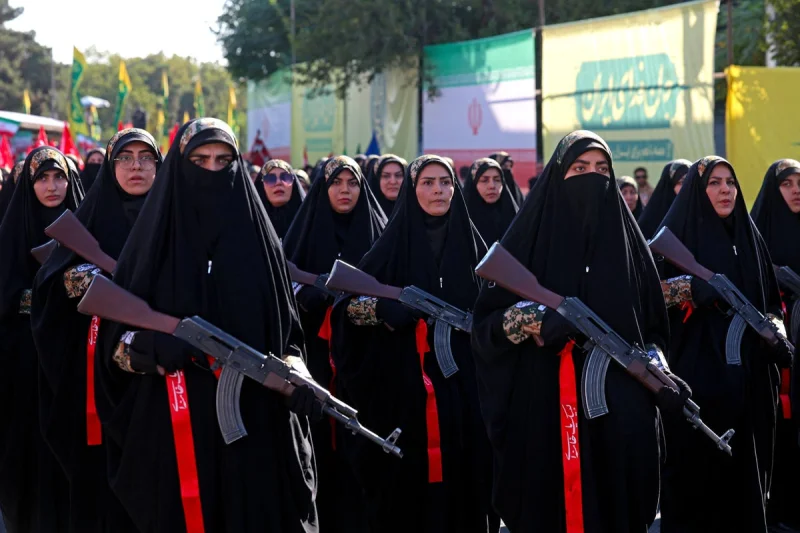
Hundreds of thousands of Iranians rallied in Tehran on Friday in a government-organized show of defiance, with participants saying they were ready to take up arms if the war widened further. The march gave Iran’s leadership a mass display of support at a moment when it is trying to project strength far beyond the capital.
The turnout was presented by state media as the biggest demonstration since the United States and Israel attacked Iran in February. On Friday morning, the broadcaster estimated more than 300,000 people were already on the streets, and Gen. Hassan Hassanzadeh later said more than 600,000 had registered to take part, with more than 1 million expected to go through training.
That scale mattered because the rally was not just a march. State media had urged Iranians for days to join the campaign, and officials said the volunteers would form an additional layer of security alongside the Revolutionary Guard and the Basij militia. State media also said training with assault rifles would begin soon, though no start date was given.

President Masoud Pezeshkian watched the march with military commanders and other senior officials as participants moved through downtown Tehran in combat uniform and carrying flags. Some trampled the flags of the U.S. and Israel, and others chanted “Death to America” and “Death to Israel.” The display also included anti-aircraft batteries, Female Guard members in black headscarves seated with truck-mounted machine guns, and drones that the Guard said had been used against ships in the Strait of Hormuz.
Marzieh Afaghi, who attended with her toddler and husband, said she wanted to tell U.S. President Donald Trump that Iranians had no fear of his threats against their homeland. She also said no one in history could invade Iran and remain there. Her words captured what officials were trying to sell the rally as: unity, defiance and a readiness to absorb more pressure.
But the pressure is not abstract. Iran is under worsening economic strain from a U.S. naval blockade of Iranian ports and new U.S. sanctions, and the government also said on Friday that it had attacked a Togo-flagged oil tanker, the Trend, for what it called an illegal attempt to pass through the Strait of Hormuz. The U.K. Maritime Trade Operations center said a tanker was hit by a projectile and that a fire on board was extinguished. UKMTO said ship transits facilitated by the U.S. military off Oman averaged 24 a day over the past week, and overall traffic remains about 90% lower than before the war.
The gap in the government’s message is still there: it can count registrations, but it has not said how many of those more than 600,000 volunteers will actually be trained and become usable defenders. Hossein Taeb said the new recruits would be ready for “full-fledged defense” and that similar rallies would soon be held in other cities, which suggests Tehran sees Friday’s turnout as the start of a wider campaign, not a one-day show.