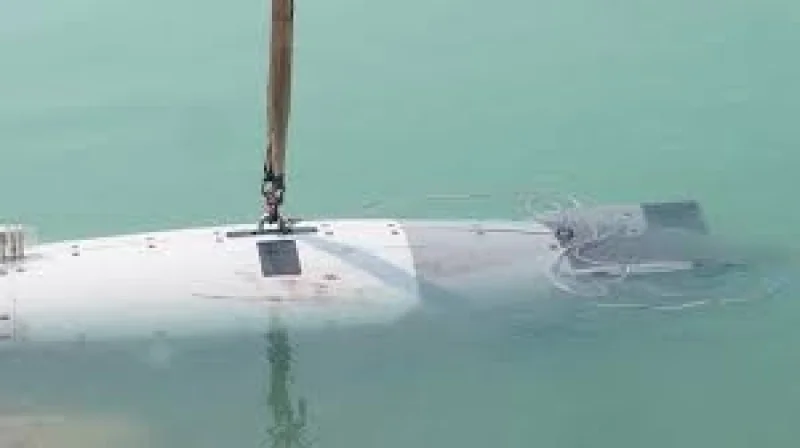
Iran’s Revolutionary Guards said on Tuesday that they had captured a U.S. uncrewed submarine at the entrance to the Strait of Hormuz, setting up a sharp clash over one of the world’s most sensitive sea lanes. Iranian state media identified the vessel as a Dive-LD built by Anduril.
The claim landed quickly because the waterway matters and because the drone was being used where maritime surveillance is most exposed. The U.S. military said the underwater drone had malfunctioned more than a day ago while surveying regional waters in support of ongoing operations, and said it was an older model that did not carry classified sonar or radar equipment.
Iran’s Revolutionary Guards Navy said, in a statement carried by state media, that it had trapped “one of the most modern, intelligent and unmanned submarines of the terrorist American army at the entrance to the Strait of Hormuz,” and said the submersible was equipped with the latest technologies. But the Pentagon’s account points in a different direction: the drone had already failed before the Iranian announcement, and the model described by U.S. officials was not carrying sensitive data when it went offline.

That gap matters because it leaves open the central question behind Iran’s announcement. If the vehicle drifted or remained stranded after the malfunction, then the claim of capture may amount to taking possession of a disabled drone rather than seizing an operational one. said it could not independently verify Iran’s claims, and Anduril did not respond to a request for comment.
Dive-LD is a 19-foot, or 5.8-metre, submersible that Anduril says can operate for up to 10 days without returning to base and dive to depths of as much as 6,000 metres, or 19,700 feet. The U.S. military has been investing heavily in unmanned naval systems like it to cover large stretches of ocean more cheaply, gather intelligence and track other ships and submarines without putting sailors at risk.
What Iran actually recovered, and in what condition, is the detail that now matters most. If the vehicle was intact, it would still mark a notable piece of hardware in Iranian hands. If it was not, then the more consequential part of the episode is the distance between what Tehran announced and what Washington says had already happened more than a day earlier.