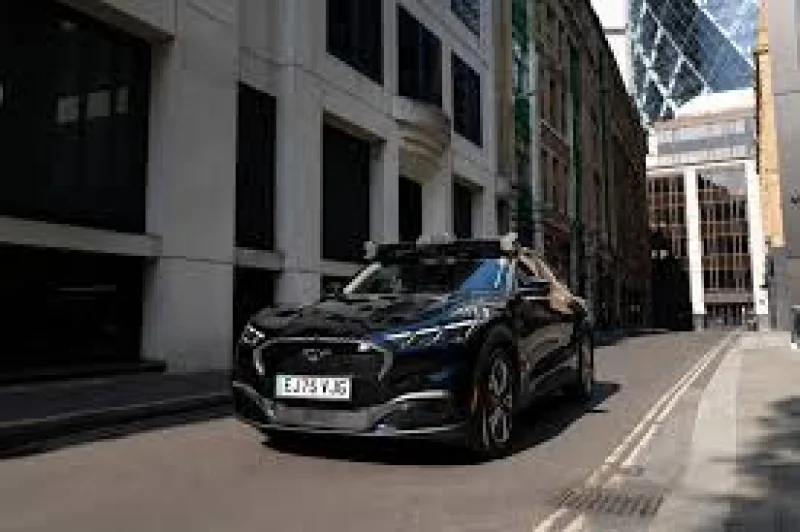
Uber rolled out 15 autonomous Ford Mustang Mach-E vehicles in London this week, putting driverless taxis onto some of the city’s busiest streets with a supervisor still on board. The cars are running in partnership with Wayve, but they are not yet allowed to operate without a human in the vehicle.
The launch matters because it is Uber’s biggest real-world autonomous test yet in a city where roundabouts, cyclists, pedestrians and roadwork create a far harder driving problem than a mapped suburban loop. Kendall said Wayve trains its AI on millions of hours of driving experience and has driven in more than 500 cities across Europe, Asia and North America, a claim meant to show the system can handle places it has never seen before.

The vehicles can travel anywhere within London, but they cannot yet make airport trips. That limit reflects the rules still in place on the roads: London regulators have not given the green light for full autonomy, so a supervisor must be ready to intervene if needed. In practice, that is exactly what happened when a CBS News crew called one of the vehicles; it operated on its own at first, then got stuck in a narrow passageway and the supervisor took over and drove.
That gap between the pitch and the reality is what makes the rollout notable. Uber is selling the ride as autonomous, but the service still depends on a human backstop, which means the public is seeing a partial version of robotaxis rather than the fully driverless system that has long been promised. Wayve’s investor base includes Uber, Nvidia and Microsoft, while its chief competitor, Waymo, has been mapping London with its vehicles but has not yet launched public service there.
Sarfraz Maredia said Uber does not see robotaxis as a near-term threat to black cab drivers, even as the market shifts around them. Transport for London statistics put the number of black cab drivers at about 25,000 in 2010 and roughly 16,000 today, a decline that shows the trade has already been shrinking long before driverless taxis were ready for mass use. For now, the bigger question is not whether London will see more autonomous cars, but when the city will finally let them operate without someone in the passenger seat ready to take the wheel.