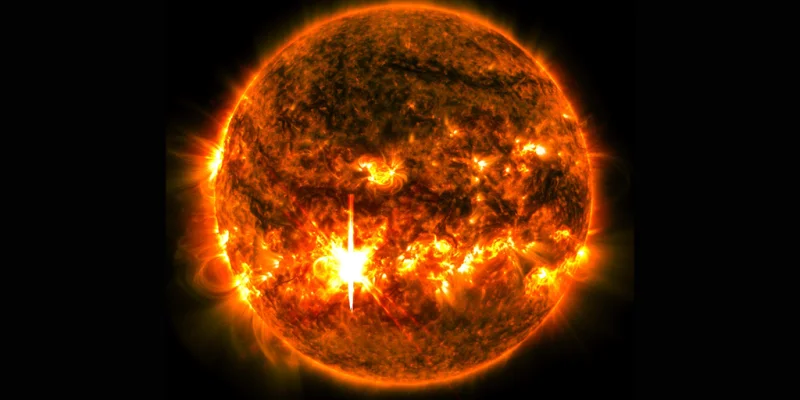
A powerful M6.9 solar flare erupted from the sun on August 25 and sent a coronal mass ejection toward Earth, with early models pointing to a glancing blow by Friday morning. The flare peaked at 6 a.m. EDT and came during a burst of three strong solar flares in less than 24 hours.
The flare sits in the second-strongest category of solar eruptions. Solar flares are ranked in five classes, from A and B through C, M and X, and the M-class event was strong enough to trigger multiple radio blackouts across Earth as it erupted.

That is why scientists are watching the CME so closely now. Solar flares can disrupt radio communications, electric power grids and navigation signals, and NASA says they also pose a risk to spacecraft and astronauts. The CME could arrive later this week and may set off a geomagnetic storm with aurora activity.
There is a catch. Even if the CME reaches Earth on schedule, only a limited number of locations in North America will be able to see the celestial event, and the display depends on how the CME hits and when its magnetic field meets Earth. If the CME lines up with a high-speed solar wind stream, geomagnetic activity could intensify and the odds for auroras could improve.
The next step is simple: wait for the CME to arrive and see whether it delivers only a glancing blow or something stronger. Early models put that first window at Friday between 6 and 7 a.m. EDT, but the exact timing will hinge on the impact itself.