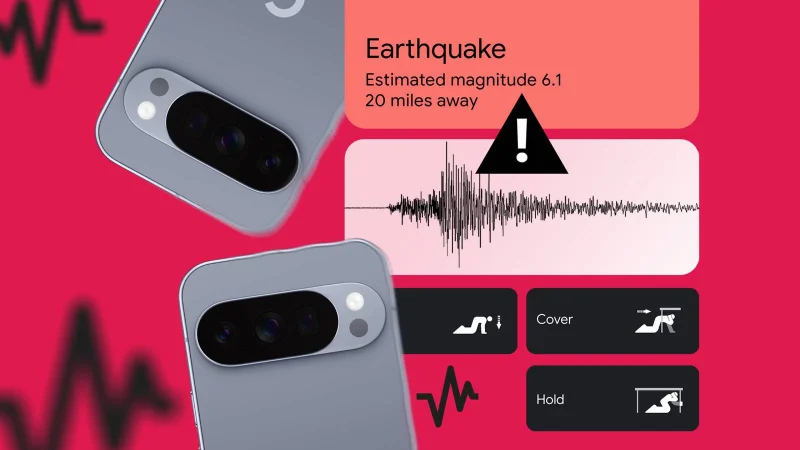
Google has expanded the Android Earthquake Alerts System from 98 countries and regions to more than 200, turning a feature that once felt optional into something far more widely embedded on Android phones. On October 15, 2026, the company said the system can now reach far more people with warnings meant to arrive before the strongest shaking does.
That matters because many people will never open a settings screen to look for it. The alerts can already be running in the background on a phone, and Ben Khalesi says he wanted to explain how the system works before anyone hears it go off at 3 AM. He is not alone in asking whether a phone feature like this does anything useful, and Google’s answer is that it can give some people seconds and others up to two minutes to get under cover.
The system starts with the phone’s accelerometer. When enough devices in the same area pick up the fast primary waves that begin an earthquake, Google’s servers use that dense cluster of data to estimate the epicenter and send warnings to nearby phones before the destructive secondary waves arrive. On the US West Coast, the warnings do not come from that phone network at all. They come from ShakeAlert, which draws on 1,675 dedicated seismic sensors across California, Oregon and Washington.

Android sorts every alert into three levels, and the lowest is Be Aware. Google sends that alert when it detects an earthquake of magnitude 4.5 or greater but expects only light shaking where the user is. In practice, that means a Be Aware message is treated like a regular notification because the danger is limited. It follows a phone’s volume settings and respects Do Not Disturb. Google has not laid out the same kind of public, plain-language threshold for the two higher tiers in the way it has for Be Aware, but the structure is meant to escalate with risk rather than surprise people with a single one-size-fits-all warning.
That promise comes with an asterisk. Google says the feature can be highly useful, but it also had a false alarm in Brazil in February 2025. Khalesi put it bluntly: he thinks this is one of the most important software features ever, even if it has had misfires. The company also points to a real-world test in June, when back-to-back magnitude 7.2 and 7.5 earthquakes hit Venezuela and its alerts reached 11.4 million people, with some users getting only seconds and others getting as much as two minutes to take cover.
The bigger story is that Google is trying to make earthquake warnings work in places that do not have a national system of their own. Its approach uses billions of ordinary Android phones as a crowdsourced sensor network, and that is what makes the expansion important today. The same phone that sits quietly in a pocket can become part of a warning grid before a user has time to think about it. The unresolved question is not whether the system is reaching more people now. It is how often those three alert levels will be right when the ground starts moving.