North of North is on Netflix Thursday, and the reason people are looking for it now is not just the comedy on screen. The show’s second season arrives after Stacey Aglok MacDonald and Alethea Arnaquq-Baril pulled off something that, by their own planning, only works if you can build a scripted TV production in the Arctic and keep it alive through weather, logistics and shortages.
Anna Lambe stars as Siaja, a young Inuk mother who leaves an unfulfilling marriage to reinvent her life in Ice Cove. That story may feel intimate, but making it meant proving that a full production could run in Iqaluit, the capital of Nunavut, where the crew had to be convinced that hotels, service providers and truck rentals existed in enough quantity to support the shoot. In plain terms, this was not a normal location job with a scenic backdrop. It was a feasibility test before it was a television series.
The creators said the series could only be filmed in Iqaluit, and they had to show their backers how. They conducted a feasibility study, then leaned on a system built around local permissions and long-distance improvisation. City council had to approve the rental of the Iqaluit Curling Club so it could become a temporary studio for Season 1. Most sets were built in Toronto, taken apart, palletized and loaded to fit the cargo plane’s fuselage. When possible, other materials went by sea during the short thaw, while building materials and boxed water moved by sealift. Even generators arrived drained of fuel and had to be restarted by a local.

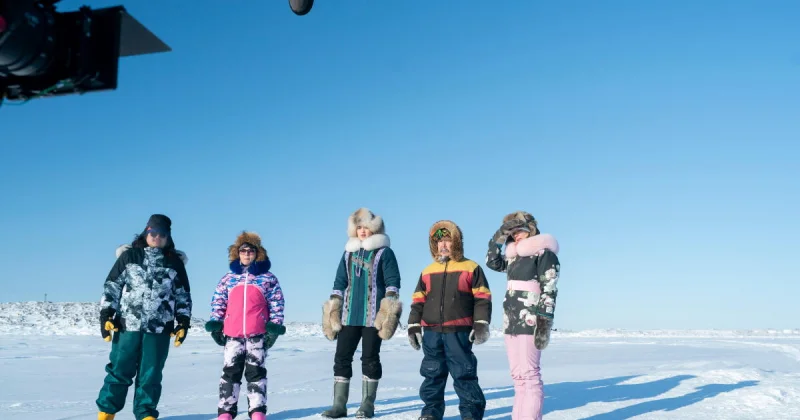
The Arctic itself kept changing the plan. Extra drivers were hired just to shuttle crew to hotel bathrooms because portable washroom pipes would have frozen. Costume designers used social media to ask travelers to carry items from Ottawa or Toronto. The crew built the “Nunavut arm,” a jib mounted on a pickup truck’s flatbed for wide exterior shots, and one camera operator built a custom housing that let him keep his hands warm at –40 degrees Celsius while still flying a drone. Hair spray stopped working properly in the cold. In Season 1, filming also paused when a mining symposium took over the town’s hotels.
Season 2 brought its own problem. A hotel renovation forced the producers to ship some sets to Toronto and shoot those scenes on a soundstage, a workaround that showed how fragile the production still was even after Season 1 proved the model could work. That delay pushed the Arctic shoot later in the year and left less time for postproduction, which is the kind of squeeze that can turn a finished season into a scramble. When the Iqaluit shoot finally began this March, the weather was –39 degrees Celsius.
Arnaquq-Baril said the point was never just the landscape. Once you get to the Arctic, she said, Northern Manitoba and Northern Ontario do not cut it, because the houses, the people and the infrastructure are all different. That difference is what gives North of North its sense of place, and it is also what made the production so expensive and so unusual. The tradeoff for authenticity was a process that demanded extra planning, more shipping and more work around things that most productions never have to think about.
That is why the season’s arrival matters now. North of North did not simply film in a cold place; it was built around the fact that the Arctic changes how television gets made. The unresolved part is not whether the show can return to that world, but how much more margin the producers will have the next time they try to do it.