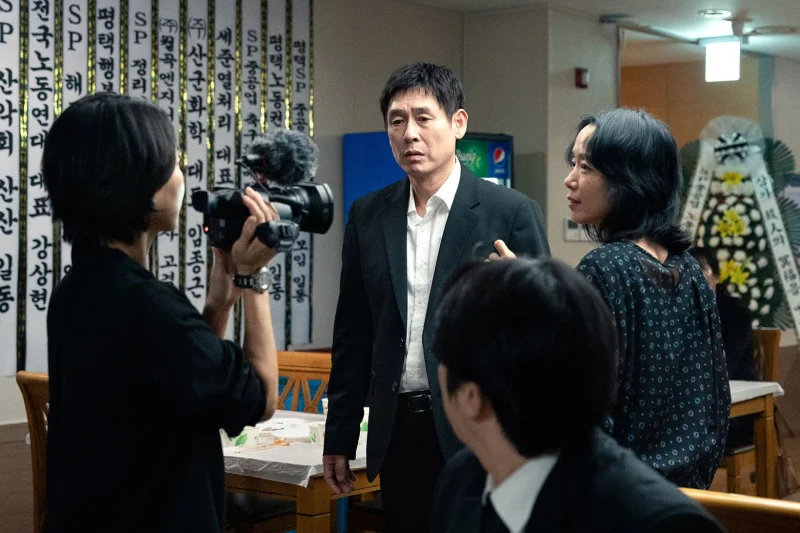
Netflix has released Possible Love, a new film from Burning director Lee Chang-dong that follows a novice documentary filmmaker into the wreckage left behind by factory layoffs and a corporate buyout. Ye-ji enters the story looking for workers to film and ends up pulled into the lives of Ho-seok and Mi-ok, a couple carrying the damage of a struggle that never really ended.
That is the reason people are looking for the movie now: it is not just another drama about work, but a story about how labor pain becomes material for the camera. Ye-ji applies for a grant to make a film about South Korea’s factory workers, and one person on the funding panel presses her to think about something more current, like A.I. The question hangs over the project because Possible Love is set in the present tense, where old injuries compete with newer anxieties for attention.

Ho-seok gives the film its weight. He is a welder whose company was bought and stripped for parts by a private equity firm, and two years after his union’s brutal confrontation with the police he is still barely able to talk about what happened. He keeps going to group therapy with other laid-off workers who still have not found new jobs, which makes his silence feel less like a personal failure than the aftershock of a system that has already moved on. Ye-ji meets him at a funeral for one of his former colleagues, who died by suicide, but she first meets Mi-ok there because Ho-seok cannot bear to go inside.
The film’s sharpest turn comes after that. Ye-ji grows close to Mi-ok while waiting for Ho-seok to crack, and the relationship between the two women becomes more than a professional arrangement. Mi-ok shares a memory from childhood about her mother working in a car wash, and Ye-ji answers with the kind of instant approval that sounds supportive but also reveals how quickly she turns lived pain into narrative value: “That’s a great story.” Later, Mi-ok furtively photographs Ye-ji’s leather backpack and checks the image to see what it costs, a tiny act that exposes the distance between their worlds even as they keep talking.
That is where Possible Love stops feeling like a clean portrait of empathy and starts feeling like a movie about extraction in another form. Ye-ji is plainly interested in the workers, but the film also leaves room for the harder reading: she may be drawn to Ho-seok because his pain will play well on camera. The nearly three-hour length gives the story room to let that friendship deepen before the project itself becomes harder to separate from the people inside it, and that is what lingers at the end — not a finished documentary, but the question of what Ye-ji is taking from Mi-ok even as she seems to be listening.