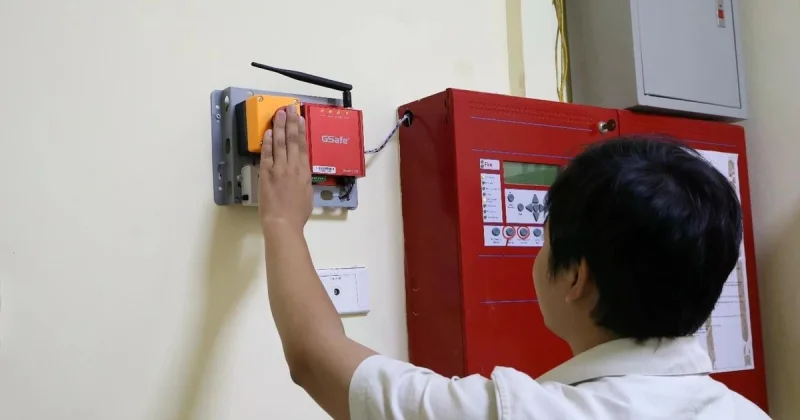
Firefighting and Rescue Team No. 12 is pushing establishments and businesses in Area No. 12 to install fire alarm communication equipment, as Hanoi City steps up a rollout meant to speed the first report of a fire. By October 20, 2026, authorities said 6,918 devices had been installed and 57,578 establishments had agreed to take part.
The reason the push matters now is simple: the equipment gives the Fire and Rescue Police an extra way to receive information automatically, instead of waiting for someone at the scene to place a call. When an automatic fire alarm system at a facility detects an incident and sends a signal, the communication device can relay that information to the receiving center based on the connection setup. That matters most in facilities that run at night, in places with few permanent staff, and during off-peak hours, when a fire can develop before anyone is there to report it.

The rollout is also built around scale. Authorities said 100% of establishments within the deployment area had declared their data by October 20, 2026, giving the Fire Prevention and Rescue Police Department of Hanoi City Police a broader picture of where the equipment can be connected. Providing complete address, coordinates and facility information helps the Fire and Rescue Police force pinpoint an incident location more easily, which is part of why the system is being promoted as more than just another alarm line.
But the numbers also show how much still depends on facilities doing their part. The system can automatically transmit a signal, but only if the equipment is installed and linked to the existing fire alarm setup. Of the 57,578 establishments that agreed to install the devices, the report gave a total of 6,918 installed by October 20, 2026, leaving the pace of completion unclear. That gap is the difference between a plan on paper and a network that can actually shorten response time.
The broader effort fits into the fire command and control system for receiving, processing and managing firefighting operations under the Ministry of Public Security’s plan. In practice, it is a prevention tool meant to make early detection and timely handling more routine. What remains is whether the next wave of installations can move fast enough to turn a declared rollout into a working automatic reporting system across Hanoi City.