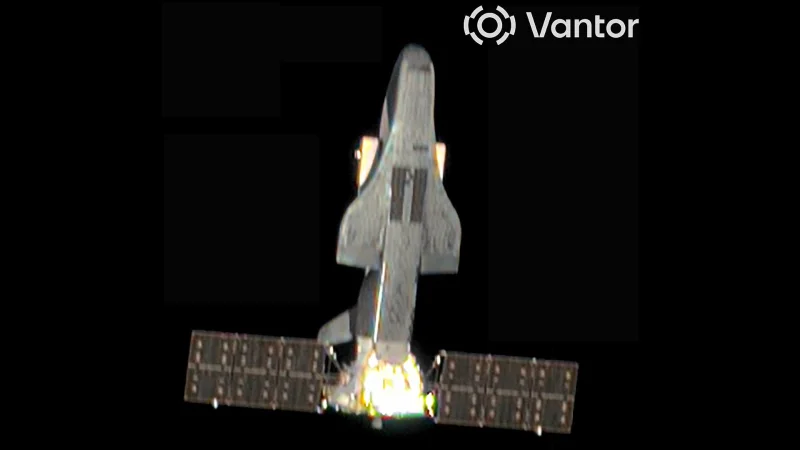
The Pentagon has released a full-resolution China Shenlong space plane photo in a Monday Defense Intelligence Agency threat assessment, putting a secretive Chinese spacecraft into a public intelligence document for the first time. The image, taken in orbit by a passing US-owned commercial satellite in 2024, shows the winged craft that has drawn comparisons with the US military’s X-37B.
The release matters because it gives a clearer look at a program that has stayed largely out of public view even as it keeps returning to orbit. The Chinese spaceplane is now on its fourth mission since 2020, and the current vehicle launched in February remains in space today. Jonathan McDowell, who tracks spacecraft using open-source orbital data, said the craft has repeatedly released and recaptured a sub-satellite, first in June and July and then again in August and September.

The photo also sharpens what is known about the design. The spacecraft has delta wings, payload bay doors, a dark heat shield and a rear-mounted service module with power-generating solar arrays. It operates in low-Earth orbit at an altitude of a few hundred miles. That is a narrower range than some US Space Force X-37B flights, including one that climbed to more than 24,000 miles before using aerobraking to set up for reentry and landing. The US Space Force has two X-37Bs flying in rotation, and the longest of the vehicle’s eight missions to date lasted two-and-a-half years.
Still, the most important part of the Pentagon’s release is what it does not settle. The Defense Intelligence Agency said spaceplanes are more suitable for certain missions than traditional satellites because of their maneuverability, but it did not say what China’s craft is actually doing in orbit. China has shown it can catch an object in space, perhaps with a robotic arm, and the vehicle now aloft has already demonstrated the ability to deploy and recover a sub-satellite. Whether that points to inspection, collection, testing or something else remains unknown.
The spaceplane is often called Shenlong in Western publications, but its official name is still a mystery, and it is not known whether China has one vehicle or several in its inventory. What Monday’s release changes is not the mission itself, but the visibility around it: a program built to stay in the shadows is now part of an unclassified US assessment, and the next clue will probably come from whatever the spacecraft does in orbit next.