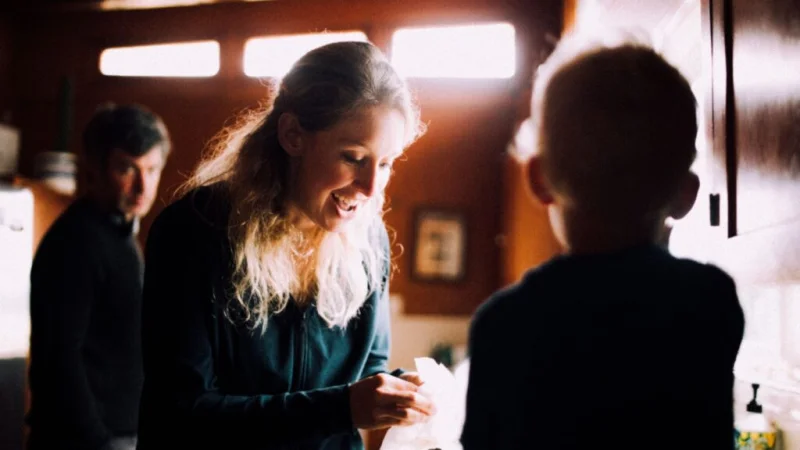
Nathan Fielder moved in with Elizabeth Holmes and her family for the 34 days before she turned herself in for prison, and that choice drives the new documentary You Can See Everything. Holmes, who was convicted in 2022 on three counts of wire fraud and one count of conspiracy to commit wire fraud, is shown preparing for her 11-year prison sentence while Fielder appears on camera more than she does.
That is why people are searching for this film now. It is not just another retelling of Theranos. It is a rare, closely observed look at Holmes at home, in the days before prison, with Billy Evans at her side and Fielder inside the house long enough to capture how they wanted the world to see her. Holmes and Evans said on camera that they wanted total access to their home lives to challenge public scrutiny of her, and the movie takes that invitation literally.
Fielder is not a distant narrator. He is the co-director, and he becomes part of the story by asking the questions Holmes has spent years trying to avoid. In one scene, he presses her about the failings of Theranos's blood-testing device, while Holmes keeps insisting the machine could do everything she said it could. That claim has been rejected over and over, yet the film lets it sit in the room, where her version of events can still collide with the record.

The stranger part is that Fielder comes away sounding half-convinced. In a post-screening Q&A in September, he said Holmes came across as “so genuine” that he wanted to believe her too, even while adding, “I know she's a liar.” That double reaction is part of the film’s pull. It is also why Billy Evans emerges as the more forceful presence around Holmes, controlling conversations, shaping her image and even speaking for her on X.
The documentary also widens the frame around the couple’s story. Holmes has spent years at the center of articles, podcasts, books and a fictionalized TV show, and the film’s access arrives just as the public is still trying to reconcile her self-presentation with the fraud conviction that ended Theranos. Tyler Shultz added another layer on Oct. 19, writing that he has always thought Holmes was with Sunny Balwani in part because of his abusive personality, knowing she could use it to her advantage. Holmes has said Balwani emotionally and sexually abused her while steering fraudulent business decisions, and he denies those claims.
What remains unresolved is not whether Holmes is still defending herself. She is. It is why a film like this can exist at all. The deeper question is why Evans and Holmes chose Fielder to live with them, and what they thought would change when a co-director spent 34 days inside their home and left with a portrait of Holmes as a disheveled, overwhelmed mother with watery eyes, split ends and the same old insistence that she never lied. She was still preparing to report to prison, but the movie suggests the harder sentence may be living with the version of herself that no camera can fully settle.