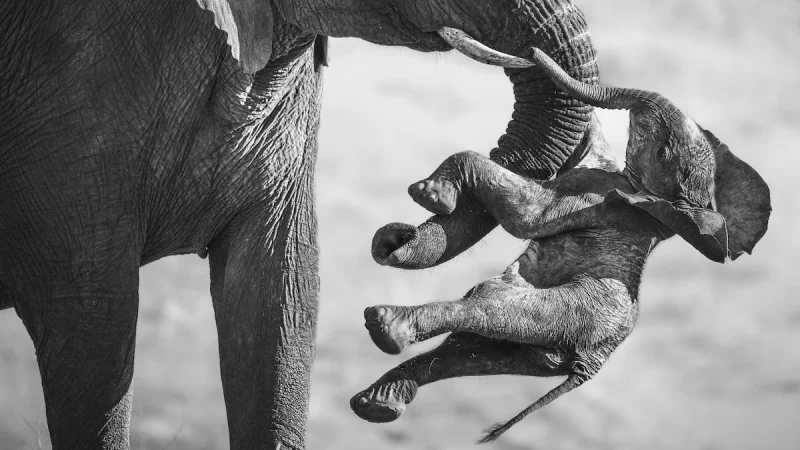
Federico Veronesi has won the 61st Wildlife Photographer of the Year title with a black-and-white image that stops the eye and does not let it go. His photograph, The Aftermath, shows a female elephant carrying a deceased calf in Namibia’s Huab River Valley.
The award was announced today by London’s Natural History Museum, which received a record 65,403 entries from 121 countries and territories for this year’s Wildlife Photographer of the Year contest. For Veronesi, the win turns a single frame into the defining image of the competition, one that judges said offered a challenging yet impactful insight into complex animal behavior.
Veronesi said he was almost unsure whether to press the shutter at all. “It was really such a private moment, I almost thought maybe I shouldn't take these photographs,” he said, before deciding it was “such a deep and fascinating window into the soul of these creatures.” After he took the picture, he watched the female elephant carry the calf up a rocky hill and occasionally set it down to feed on a small bush.

The moment was not isolated in the way it may first appear. A local elephant research project told Veronesi that the female had lost a baby a few years earlier and had since been seen picking up other dead calves. That history gives the image a harder edge and explains why the photographer, even as he framed the scene, described it as an intensely private one. He also said it may be “a way for her to try to reconnect to that experience,” and that it showed “an even higher level of complexity of emotions and reactions.”
Kathy Moran put that feeling bluntly: “Emotionally it’s a gut punch, heartbreakingly poignant. Intellectually it’s proof that animals have cognition. This photograph says it all!” The judges’ praise matched the image’s force, but the picture also lands because it resists easy comfort. It presents grief without explanation, and in doing so asks viewers to sit with behavior that feels familiar and still remains only partly understood.
The broader contest places that image inside a much larger field of work, but Veronesi’s photograph stands apart because it narrows the distance between the viewer and the animal at the center of it. The unresolved question is not whether the picture mattered enough to win. It did. It is how much more the behavior of African and Asian elephants will reveal the next time a photographer is close enough, and ready enough, to catch it.