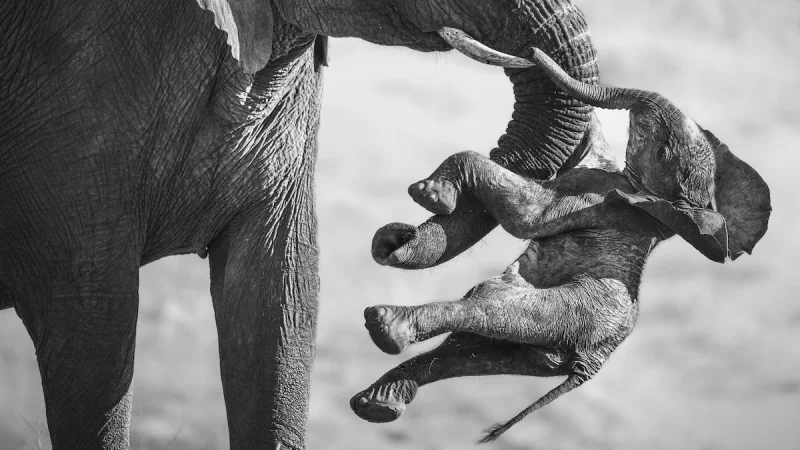
Federico Veronesi has won the 61st Wildlife Photographer of the Year for “The Aftermath,” a black-and-white image made in Namibia’s Huab River Valley that shows a female elephant carrying a deceased calf. London’s Natural History Museum presented the award today, placing Veronesi’s frame at the center of this year’s most closely watched wildlife photography competition.
The win matters because the contest drew a record-breaking 65,403 entries from 121 countries and territories, a field so large that the title now doubles as a measure of what the judges chose to elevate from the world’s wildlife work. Kathy Moran, who helped assess the pictures, said the photograph “works on so many levels,” calling it “a gut punch” and “heartbreakingly poignant,” while also describing it as evidence that animals have cognition.

Veronesi said the image began with elephant tracks he had seen the day before while leading a safari. One morning in the Huab River Valley, he followed those tracks and found the female elephant in a dry riverbed with the calf’s leg wedged between her trunk and tusk. He said the moment felt so private that he almost thought he should not take the photograph at all, but he went on to describe it as a deep and fascinating window into the soul of these creatures.
That instinct to hesitate is part of what gives the picture its force. Veronesi also said the frame was difficult to capture because it required a quick reaction and a ready camera, and he presented it in black and white to heighten the connection between animal and viewer. The result is a winning image that does not soften the scene; it asks the audience to sit with grief, instinct and memory at the same time.
The award is framed as part of this year’s Wildlife Photographer of the Year contest, but the biggest unanswered question is how the rest of the winning images were ranked behind Veronesi’s. What is clear today is that “The Aftermath” rose above an enormous international field and won on the strength of a photograph that the judges saw not only as an emotional shock, but as a rare look at behavior that still defies easy explanation.