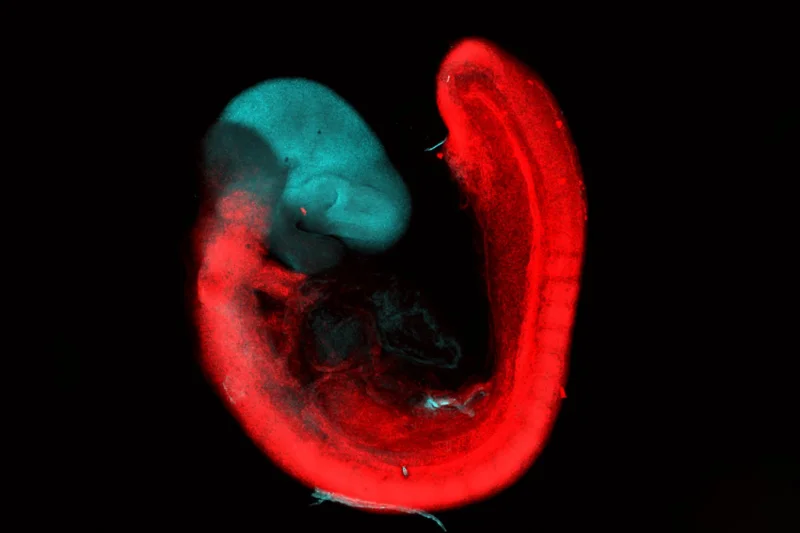
Stanford University researchers have found that the human brain’s front and back regions arise from different embryonic progenitor cells, not a single shared source. The finding suggests the brain was built from two systems that were pushed together long ago, rather than from one unified plan.
Kyle Loh said the work began with a summer student’s failed experiment, and he described the result as evolution taking two existing neural systems and moving them together spatially. That matters now because the new study offers a clearer way to grow human hindbrain tissue in the lab, where scientists have repeatedly struggled to make the right cells for research on ALS, spinal muscular atrophy and the way GLP drugs such as Ozempic and Wegovy affect appetite.
In mouse embryos, Loh and colleagues found that early brain development starts from two progenitor populations with limited self-renewal capacity. One expresses OTX2 and gives rise to neurons in the forebrain and midbrain. The other expresses GBX2 and becomes neurons in the hindbrain. The same split showed up in human cells in a dish, where hindbrain neurons and forebrain and midbrain neurons developed from different progenitor cells.

That is a sharp break from the older idea that the brain began from one common embryonic origin. Loh said the team showed for the first time that the front of the brain arises from a totally different progenitor cell than the back of the brain. He also said a single organ would probably be more efficient, but the brain still relies on that ancient two-part arrangement.
The friction is built into the biology. The hindbrain handles breathing, sleeping, eating and the beating of the heart, while the forebrain is the center of higher-level thought. A cleaner one-piece design might sound simpler, yet the body carries this older arrangement forward, and that may be why the brain has been so hard to reproduce faithfully in the lab.
The researchers also looked at early-stage embryos of chickens, zebrafish and acorn worms and found the same two-origin pattern. That pushes the origin of this shared brain architecture back at least 550 million years, and it fits with the fact that jellyfish split from our lineage about 600 to 700 million years ago and already have two separate nervous systems. The result does not settle how those two systems were merged into the brain we know today, but it gives scientists a more precise starting point for the next round of experiments.
For researchers trying to build human hindbrain neurons, the practical step is straightforward: begin with the correct progenitor cell type. That is the part of the story that may travel farthest, because better hindbrain cells could improve disease models and make the human brain easier to study one region at a time.