Sunday’s election in Saxony-Anhalt could put the Alternative for Germany in control of a German state for the first time since World War II. With the party polling at more than 40% and its nearest rival in the low 20s, the numbers are close enough to open a path to an outright majority of seats.
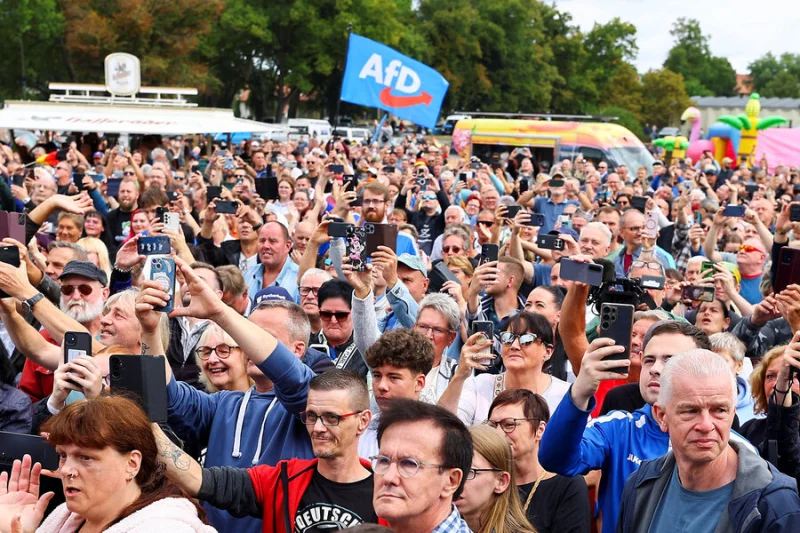
That is why Gerda Werner was grinning broadly at the party’s final preelection rally on Thursday in Magdeburg, where 6,000 people filled the hall and listened as speakers promised to deport migrants and take on Friedrich Merz’s unpopular government. Werner said, “We must change,” and added, “All the other parties talk and do nothing.”
The math is what makes the election so unusual. In Saxony-Anhalt, parties that fall below 5% of the vote are excluded from the legislature, and their share is left out of the seat count. That means the Alternative for Germany would need several of the smaller parties to stay under that threshold to turn a large vote share into a majority of seats. If that happens, it would not just finish first. It would govern alone.

That possibility lands in a country whose postwar politics were built around the principle of never again. Germany has spent decades shaping its government, culture and schools to keep this moment from arriving. The Alternative for Germany denies that it is antidemocratic, but the German government has declared it extremist, and that clash sits at the center of Sunday’s vote. The party also relishes the idea of putting Germany on a new path, which is exactly what unsettles its critics.
Marcus Böick said the prospect would break with that memory culture in a way few elections have ever done. “It would defy the legacy of ‘never again,’” he said, calling it “a watershed moment.” For the party’s supporters, the draw is simpler: Werner said, “We must change,” and for many voters that message has outweighed the warning signs.
The unresolved question now is not whether the Alternative for Germany will lead the vote, but whether the seat arithmetic gives it a majority as well. If the smaller parties fall short of 5%, the party could do more than win. It could take power in a German state on its own, and the rest of Germany would have to live with the result.