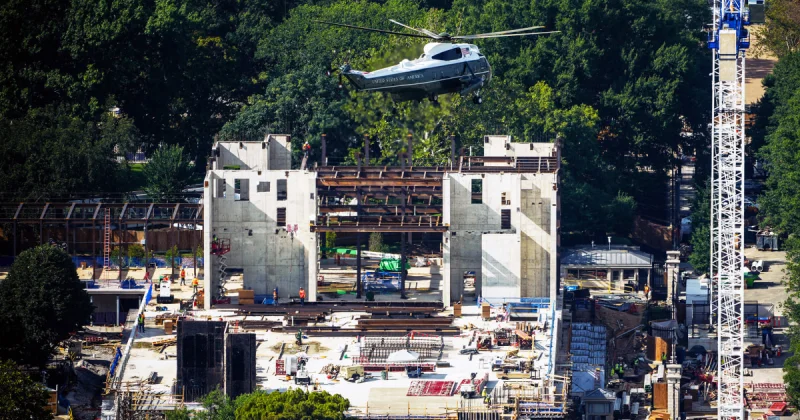
The Supreme Court on Monday let Donald Trump keep moving ahead with construction of a new White House ballroom, clearing the way for the project to continue indefinitely while a legal fight over it works through the courts. In a 5-4 ruling, the court blocked lower court orders that would have stopped the aboveground portion of the work.
The decision changes the project’s pace right now. The Trump administration told the court that construction was 65% complete as of Aug. 24, with a 250-person crew working 20 hours a day, seven days a week. The White House said the $400 million project will be financed entirely by private donations, while Secret Service funds have already covered some security enhancements. The overall plan also includes an underground component with secure locations and medical facilities.

The case was brought by the National Trust for Historic Preservation, which argued that the government had no authority to build the ballroom under a federal law requiring the express authority of Congress for construction on federal land in Washington, D.C. The Trump administration countered that other federal laws allow the president to make improvements on the White House. A federal judge ruled that the underground construction could go ahead but the ballroom itself could not be built while the lawsuit continued, and the U.S. Court of Appeals for the District of Columbia Circuit upheld that decision on Aug. 7. Chief Justice John Roberts then issued an interim decision on Aug. 21 along similar lines before joining the court's three liberal justices in dissent on Monday.
That dissent carried the sharpest warning in the case. Roberts wrote that construction of the ballroom has proceeded apace for the better part of a year and said it is likely unlawful, even as the majority said the trust likely lacks standing to sue in federal court. The court also said that mere offense, disagreement or distaste does not amount to the kind of concrete and particularized injury needed to keep the case alive.
Alison Hoagland, a preservationist in Washington and a trustee of the group, said she would suffer both professional and personal injuries if a ballroom of the proposed form and scale were built. She said the project would harm her aesthetic, cultural and historical interests. The court did not decide whether Trump has authority to carry out the construction without congressional approval, leaving the central legality of the ballroom unresolved even as the work continues.