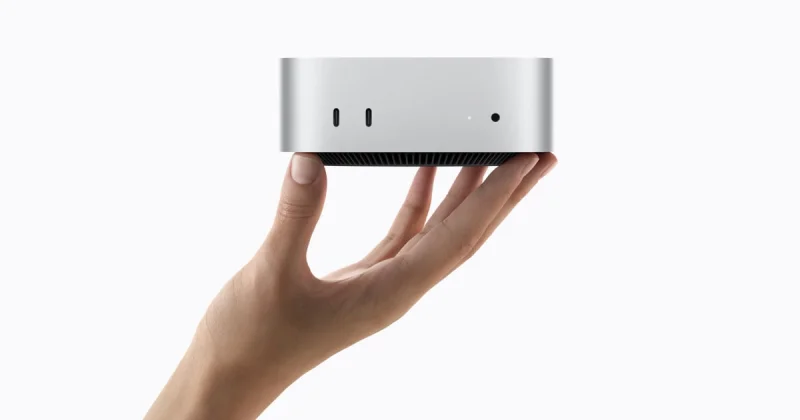
Apple has refreshed the Mac mini and Mac Studio with new chips, led by the M6 and the M5 Ultra. The update is aimed squarely at people running AI software locally, even if the hardware changes are mostly a specs bump rather than a full redesign.
The timing matters because Apple is leaning harder into a use case that has been building for months: developers and researchers using Mac minis or Mac Studios to run local large language models, often with more than one machine linked together. That is why the Mac keyword is drawing attention now. The company is not just selling faster desktops; it is pitching them as tools for software development and AI inference, which is where many users already have been pushing the machines on their own.
The M6 is the first 2nm chip in Apple’s Mac lineup. It uses a 12-core CPU with two super cores, four performance cores and six efficiency cores, plus a 12-core GPU. Apple says it can deliver up to 40 percent better multi-threaded CPU performance than the M4 two generations ago, with unified memory bandwidth up to 160GB per second. Its ceiling is 32GB of memory, which is enough for lighter local models and general development work, but not for the largest AI setups.

The M5 Ultra is the bigger statement. It will be available in the updated Mac Studio, with up to 512GB of memory, 36 CPU cores, 80 GPU cores and as much as 1.2TB per second of unified memory bandwidth. That is the kind of headroom that matters when software needs to keep large model weights, context and working data in memory at once, or when multiple AI jobs are running side by side. For many users, that matters more than raw peak speed.
Apple has been laying the groundwork for this direction since macOS 26.2 shipped last December. Its release notes said the software enabled low-latency communication between Thunderbolt 5 hosts for distributed AI inference using MLX, a setup that fits the way hobbyists and professional developers have been daisy-chaining Mac minis and Mac Studios. In other words, the company is not inventing a new market so much as formalizing one that already existed.
The catch is that the new Macs do not appear to add major features beyond the chip bump. That makes the pitch feel narrower than a typical product refresh: Apple is asking buyers to care less about what the machines can do on paper and more about how they behave under AI-heavy workloads. The company has not shown verifiable benchmarks for the M6, and it has not broken out which specific tasks besides AI inference and software development will benefit most from the higher memory bandwidth and capacity.
For now, the most important next step is simple: the updated Mac Studio is getting the M5 Ultra, and the open question is how much real-world gain the new chips deliver once they leave Apple’s charts and land in actual local AI workflows.