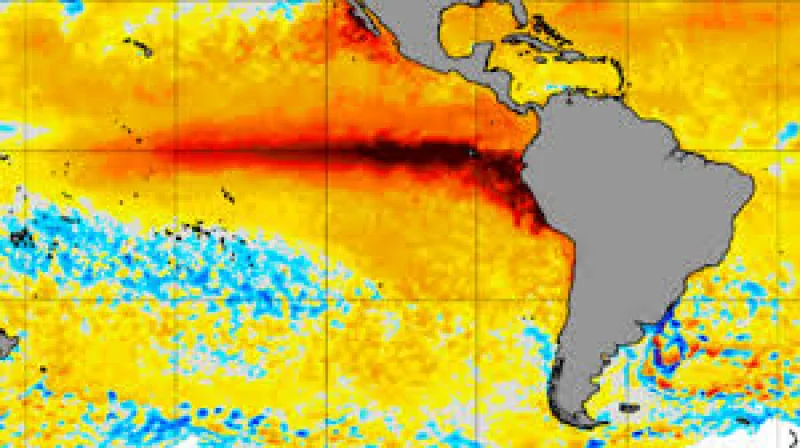
NOAA is forecasting that this fall and winter’s El Niño will be the warmest on record, a setup that could reshape weather patterns across the Atlantic and the Southern U.S. The signal matters now because the season that is about to begin is the one most likely to feel it.
El Niño is the warming of waters in a very specific part of the equatorial Pacific, and it has a big role in global weather patterns. Its opposite, La Niña, is cooler than average water in the same region. When El Niño strengthens, the Atlantic tends to see fewer tropical systems, while the Southern U.S. is more likely to face a more active storm track.
The forecast is drawing attention because NOAA is calling for an El Niño that could be the warmest on record, even though some models point to an even stronger event than the one NOAA has currently mapped out. In this context, strong means ocean temperatures in that Pacific region running 1.4°C to 1.9°C above average. Very strong means 2.0°C or higher.

Since 1950, there have been eleven weak El Niño falls and winters, seven moderate ones, three strong ones and four very strong ones. That record shows why the current forecast is drawing scrutiny: the strongest outcomes are rare, and winter projections built on El Niño alone have a limited history to lean on. Other factors can still shape the season, including preceding tropical activity, solar activity and Siberian snow cover.
For the Triangle, the question is less about labels than about what the season actually delivers. The region’s 30-year average snow total from 1991-2020 was 7.9, but that average has been a lot lower in the last five-to-ten years. The forecast does not yet say how much snow or temperature change this El Niño will bring, only that the Pacific is heading into a season that could be unusually warm for the phenomenon.
That leaves the best answer for now: the warm signal is strong, but the winter outcome is not fixed. NOAA’s call gives forecasters a starting point, not the final word on what the Southern U, the Atlantic or the Triangle will actually see.