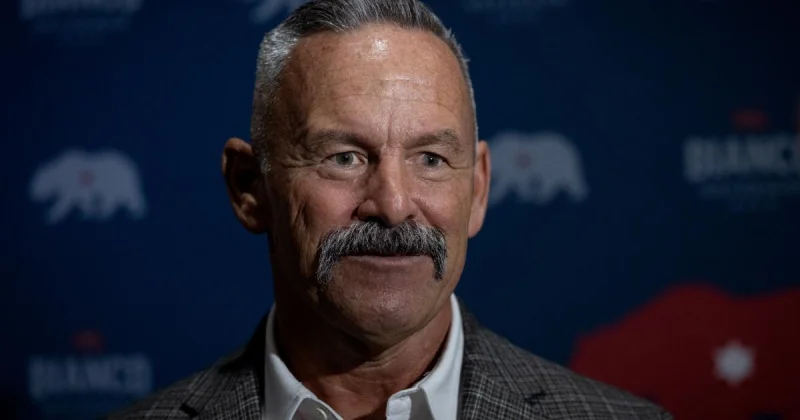
The California Supreme Court heard arguments Monday over whether Riverside County Sheriff Chad Bianco had the authority to seize more than 600,000 ballots from last year's Proposition 50 redistricting race. The case puts a stark question before the justices: can a sheriff take custody of ballots before they are counted, then order deputies to recount them?
Bianco, who later ran unsuccessfully for governor this year, said he suspected there were tens of thousands more votes cast than there should have been. He also said the seizure was part of an investigation into potential voter fraud and announced that his deputies would recount the votes.
The number at the center of the dispute is larger than the version that first drew attention: more than 650,000 ballots, seized in what was described as an unprecedented step in the United States. Two lawsuits followed, one led by the UCLA Voting Rights Project and another by state Atty. Gen. Rob Bonta. The Los Angeles Times commentary said the state high court heard arguments Monday, and that is now the moment when the legality of Bianco's move has to stand on its own.
That legal footing looked thin during the exchange. Justice Goodwin H. Liu told Bradley Hertz, “That seems bizarre,” after hearing the sheriff's position. Justice Joshua Groban pressed the broader point, asking whether, under that reading of the warrant power, a sheriff could seize ballots “even before they were counted.”
That is why the case matters beyond Riverside County. If the court accepts Bianco's theory, it could leave room for similar ballot seizures before future elections, including the midterms. If it does not, the ruling would draw a line around sheriff-led interference claims and make clear that suspicions of fraud do not, by themselves, authorize possession of ballots before the count is finished.
The answer may come later, but the shape of it is already clear: the court is being asked to decide whether an election official can turn suspicion into custody before a ballot is counted, or whether that power stops where the vote begins.