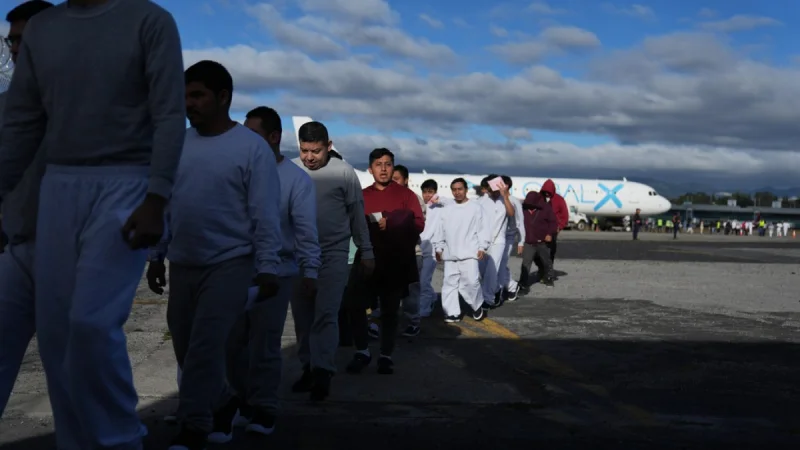
Thirty-five Mexicans deported from the United States arrived in Honduras on Thursday, landing at Ramon Villeda Morales Airport in San Pedro Sula before being moved by bus. The arrival is the latest sign that U.S. authorities are increasingly sending Mexican nationals through Central America before they are returned home.
For readers watching Honduras, the reason this matters is not just the number on the plane. The route itself has changed. Mexican deportees have been showing up in Honduras and Guatemala instead of being sent directly back to Mexico, and the total has already climbed to more than 2,300 Mexicans under this handling. That shift has turned airports in San Pedro Sula and Guatemala City into transfer points in a process that is now unfolding in public view.

The image from Thursday was plain enough: migrants walked off the plane at Ramon Villeda Morales Airport, then boarded a waiting bus. In Guatemala, deported migrants have also arrived at La Aurora airport in Guatemala City. Together, the scenes point to a wider pattern in which the United States is using third-country deportations to move Mexican nationals closer to home while avoiding a direct handoff at Mexico's border.
That is where the friction sits. Mexico is objecting to the deportations, yet the United States is still sending Mexican nationals to Guatemala and Honduras. The arithmetic is also left partly unanswered. Of the more than 2,300 Mexicans sent through this route, the public record here does not say how many went to Honduras and how many went to Guatemala, only that both countries have been used. The lack of a clear breakdown matters because it leaves the scale of each transfer point, and the terms behind them, in dispute.
The next move is not spelled out in the report, but the direction of travel is. U.S. authorities are no longer treating return to Mexico as a single-step process. For Mexicans caught in that system, Honduras is now part of the journey home.