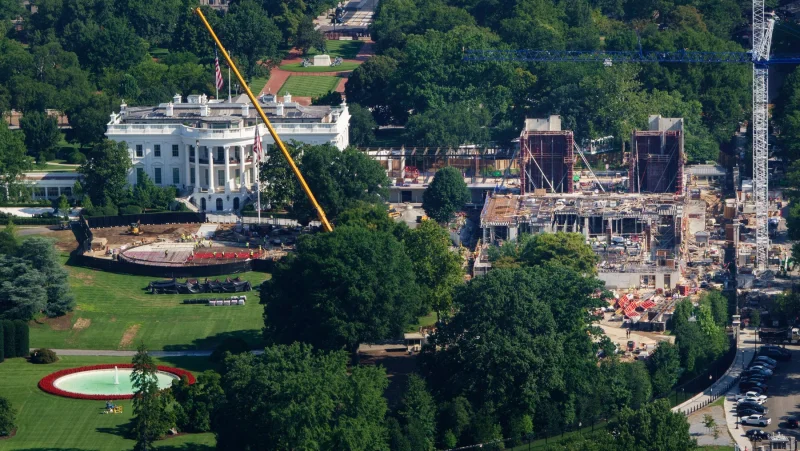
A federal appeals court blocked ongoing construction of Donald Trump’s White House ballroom last week, halting the most visible piece of his renovation push just as questions over how he is paying for it sharpen. Trump has ordered sweeping work across the complex, and administration records show the plan now runs to roughly $900 million.
The court’s intervention matters because the ballroom was only one part of a far broader remake. Trump demolished the East Wing to make room for it, paved over Jackie Kennedy’s Rose Garden to recreate Mar-a-Lago’s poolside patio, remodeled the fountains in Lafayette Park and put a helipad in the middle of the South Lawn. He is also planning a new visitors center to replace the one he bulldozed.
The money trail is what has turned the project from a display of taste into a political and legal fight. The Post reported that most of the financing is being pieced together from funds that were allocated to other federal agencies and White House maintenance accounts, and that the administration has redirected about $875 million in taxpayer funds into a Repair and Restoration account overseen by the White House Executive Residence. Before Trump returned to office, Congress would typically put about $2.5 million a year into that account.

That gap has become the center of the dispute. Trump had said the ballroom would be covered by donations, but the scale of the redirected taxpayer money suggests the public is already carrying most of the cost. The White House has defended the work as part of long-overdue renovations and has tied it to the nation’s 250th anniversary of independence, saying the project will beautify the White House for generations.
The appeals court gave the fight a new edge by grounding its order in the Constitution, writing that the White House is the People’s House and that Congress, under the Property Clause, has plenary control over the building and the land around it. The judges also said each president is a temporary tenant, not the owner, of the White House.
What happens next is not yet spelled out in the record that is public, which leaves the ballroom in a strange place: legally stalled, politically defended and financially entangled with a much larger renovation program. The bigger unanswered question is how much of the $875 million now parked in the repair account will end up on the ballroom itself and how much will go to the rest of Trump’s White House overhaul.