


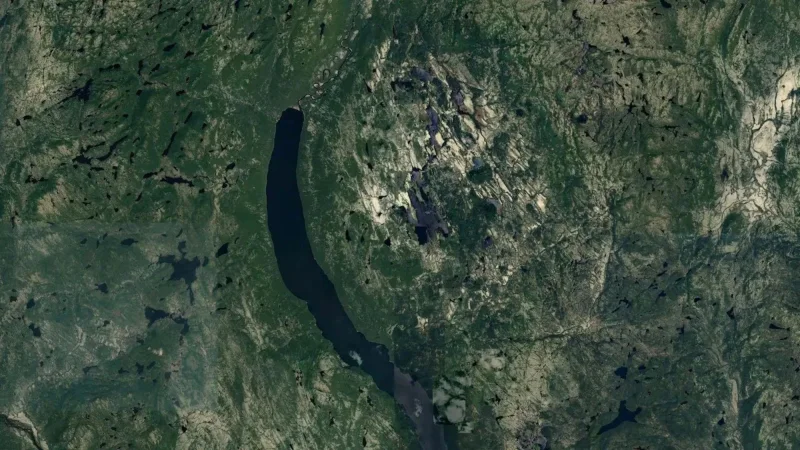
What began as a camping route check on Google Maps ended with a possible new chapter in Canada’s impact record. Joël Lapointe, an amateur astronomer, noticed odd terrain centered on Lake Marsal in Quebec’s Côte-Nord region in 2024, reported it to a crater crowdsourcing site tied to Western University, and later saw scientists provisionally confirm it as a meteorite crater.
The feature, now called Uhackatik with approval from the Innu Council of Ekuanitshit, is about 390 million years old and roughly 15 miles, or 25 kilometers, wide. That makes it a rare large impact structure to be added to the scientific record, and one that researchers say may help them understand how impacts behave on the Moon, Mars and other rocky worlds.

The confirmation came after Western planetary geologist Gordon Osinski visited the region in 2025. In the field, he said the team found shock metamorphic effects in the rocks, impact melt rocks preserved in the area and shatter cones that were easy to see. Those are the kinds of features geologists look for when an ancient circular scar has been worn down over millions of years, and they help distinguish an impact crater from ordinary geology.
The finding is still preliminary. The work has not yet been peer-reviewed, and the researchers are expected to present it at the 88th Annual Meeting of the Meteoritical Society in Frankfurt, Germany in August. That matters because the next step is not just to show the crater exists, but to press the rocks themselves for a cleaner answer about what happened there.
Osinski has already called the site one of the biggest crater discoveries in recent years. He said the last comparable find was the roughly 31-kilometer Hiawatha structure in Greenland in 2018, though that feature is buried beneath ice and its diameter remains uncertain. Uhackatik is different: it is exposed, visible and already giving up the physical traces that support an impact origin. For scientists, that means the open question is no longer whether something happened there. It is how much the preserved rocks can still reveal before erosion and time erase the rest.
