


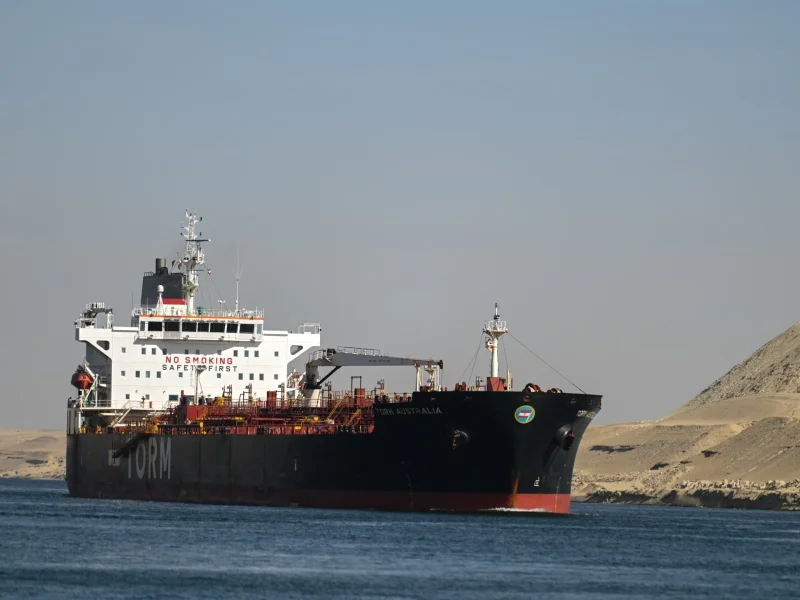
Two tankers carrying Saudi crude to Asia reversed course in the Red Sea after the Houthis announced a naval blockade of Saudi Arabia on Monday. The vessels, Rodos and Xin Long Yang, had been sailing toward Bab al-Mandeb before turning north with a combined 2.8 million barrels aboard.
The move matters because Bab al-Mandeb is the chokepoint linking Yemen and the Horn of Africa, and about 6 million barrels of crude a day that pass through it to Asia are now at risk. For Saudi Arabia, the reversal is the first visible sign that the threat is no longer theoretical; it is already changing where oil ships go.
Saudi Arabia had relied on its own workaround when the Strait of Hormuz became unreliable. Crude could move by pipeline to Yanbu on the Red Sea, then continue by tanker, allowing exports to keep flowing when other routes were under pressure. During the period when Hormuz was essentially closed for most of the past five months, Yanbu became the outlet that mattered most.

The numbers show how important that backup had become. In June, Yanbu exported about 4.1 million barrels per day and rerouted roughly 64 percent of the Saudi oil that would otherwise have left through Hormuz. That made the Red Sea route central to Saudi exports, not just a spare lane.
Now that lane is under strain. Asian refiners are considering sending oil northwest from Yanbu through Egypt's Suez Canal, into the Mediterranean, around Africa and the Cape of Good Hope, and then on to Asia. It is a possible detour, but it is a punishing one. The Suez route would add weeks to delivery times and substantially raise freight and fuel costs.
That is the friction at the center of the story: the Red Sea workaround was built to reduce Saudi dependence on Hormuz, yet it is now being tested by a threat at the southern end of the same export system. A route designed to keep oil moving is being forced to look for an even longer path.
What happens next depends on whether the blockade announcement turns into sustained pressure on shipping. If it does, more cargoes may be rerouted through the Suez Canal, even at higher cost and slower speed. If it does not, the return of Rodos and Xin Long Yang may prove to be only the first sign of how quickly traders are redrawing routes when the Bab al-Mandeb Strait comes under threat.
