


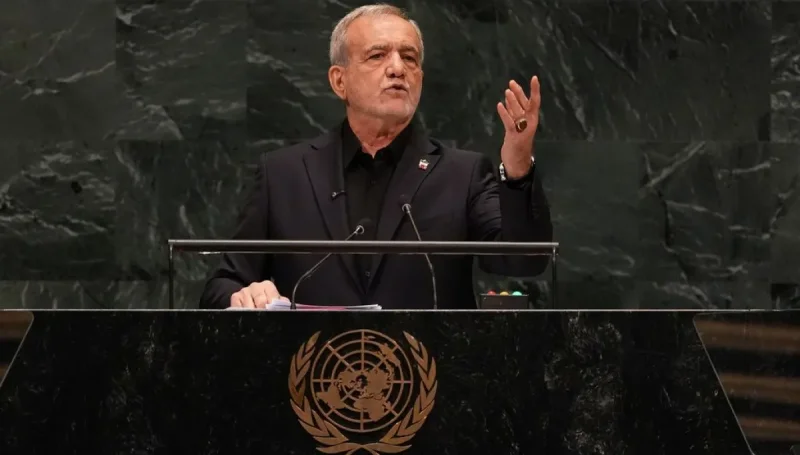
Masoud Pezeshkian used a interview on Thursday to deny that Iran wants a nuclear bomb, saying the country is willing to let its nuclear program be inspected and would dilute uranium if needed. The Iranian president’s remarks put a direct public line under a dispute that has shaped the Middle East and kept Iran under intense scrutiny.
That is why the Masoud Pezeshkian interview is drawing attention now: it came while Iran’s nuclear program remains one of the region’s most sensitive flashpoints, and while Washington and Tehran are still shadow-boxing over the terms of any future deal. Pezeshkian said Iran had no problem with verification and that lowering uranium levels would not be a major issue, a notable concession from a government often described as defiant on enrichment.

He tied his answer to Iran’s own internal red line, saying the Supreme Leader had already declared nuclear weapons unholy and illegal under a religious decree. Pezeshkian also blamed Washington for the nearly seven-month war in the Middle East and accused it of blocking diplomacy, placing the burden for the deadlock on the United States rather than Tehran.
The friction is hard to ignore. Iran has long been under international scrutiny for enriching uranium far beyond the levels usually needed for civilian nuclear power, and President Donald Trump has pointed to that enrichment as his central rationale for launching Operation Epic Fury in February. Pezeshkian’s denial does not erase that record; it only sharpens the gap between Iran’s public assurances and the fears that have driven sanctions, threats and military action.
Pezeshkian said Tehran and Donald Trump reached an agreement in June, describing it as a signed framework that both sides were still willing to move forward with. He said the Strait of Hormuz was open and had not been closed, pushing back on any suggestion that Iran had used that chokepoint to escalate further. The June memorandum of understanding was intended to halt hostilities and begin a 60-day process toward a broader agreement, but the contours of any revived deal remain unresolved. For now, Pezeshkian has drawn his line in public: Iran says it does not want a bomb, but the question is what limits, inspections and timing would make that claim stick.
