


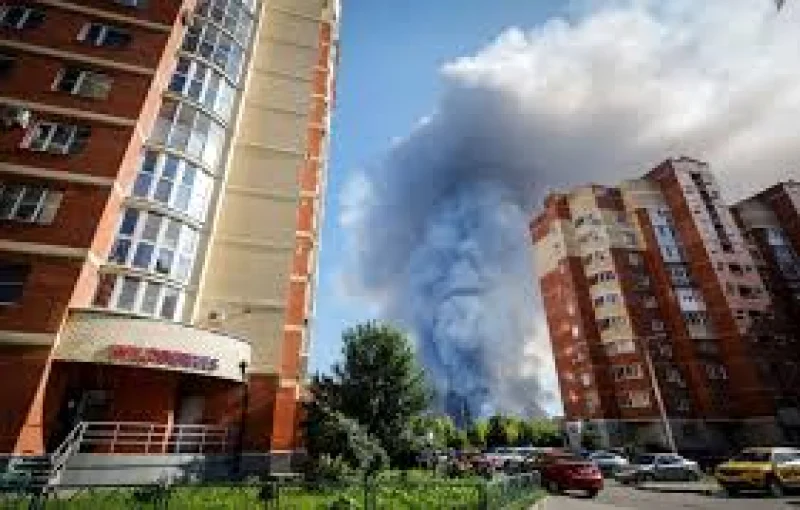
Ukraine sent 400 drones at Moscow overnight, and Russian officials said the strike wounded two people and set buildings ablaze in the capital. It was the latest sharp escalation in a war that has increasingly spilled across the border and into Russian territory.
The attack came a day after Russia carried out one of the largest ballistic missile attacks on Kyiv of the full-scale war, keeping the cycle of retaliation moving at speed. Ukraine has intensified its strikes on Russian territory in recent months, and Kyiv has described them as retribution for more than four years of bombardments against its own territory.

For Moscow, the scale matters as much as the damage. Four hundred drones is not a stray raid or a symbolic jab; it is a mass overnight strike that forces the city to defend against a wave of threats at once. Russian officials did not say how many were intercepted or how many reached the capital, leaving the full effect of the assault unclear even as they confirmed injuries and fires.
Boris Nadezhdin, who said he had run out of political road after a small fine on Friday and being designated a foreign agent this month, was not part of the military exchange itself, but his description of the narrowing space around him echoed the hardening mood that now frames the conflict. The attacks on Moscow and Kyiv are no longer isolated blows. They are part of a widening exchange in which each side presents its strikes as a reply to the other.
What comes next is not hard to see. If the pattern holds, Russia will answer, Ukraine will press on, and the capital cities will keep absorbing the cost of a war that is now being fought as much through retaliation as through strategy. The unanswered question is whether the next round will be larger still, and whether either side can slow a cycle that now appears to be accelerating.
