


Charles Q. Brown, Jr. has coauthored a new Foreign Affairs piece that asks a question with immediate political weight: what America’s armed forces can do for democracy, and what they should never be asked to do. Brown, a retired U.S. Air Force general and the 21st Chairman of the Joint Chiefs of Staff, joins Peter D. Feaver and Andrew Kragie in arguing that the military’s power is real, but not boundless.
That matters now because Brown’s name carries more than academic interest. He is an Executive in Residence at Duke University, while Feaver, a professor of political science and public policy there, leads the Program in American Grand Strategy, and Kragie is an alumnus of that program and a lawyer in North Carolina. Together, they are writing for readers who care about civil-military relations at a moment when the military still draws broad public respect.
The piece traces the argument back to the country’s founding, saying the Declaration of Independence complained that King George III had “affected to render the Military independent of and superior to the Civil power.” It also points to George Washington, who deferred to the Continental Congress throughout the Revolutionary War even when its orders were slow and uneven, because he saw his authority over the Continental Army as coming from the people’s representatives.

That history is not there for decoration. It is the frame for a warning that lands squarely in the present: Americans trust the military more than civilian branches, and recent presidents, Donald Trump and Joe Biden, both leaned on it during COVID. The military is also enormous, with a budget two to three times that of its nearest competitor, and the authors say it can do things no other military in the world can do. They point to the recent capture of Nicolàs Maduro as an example of that reach.
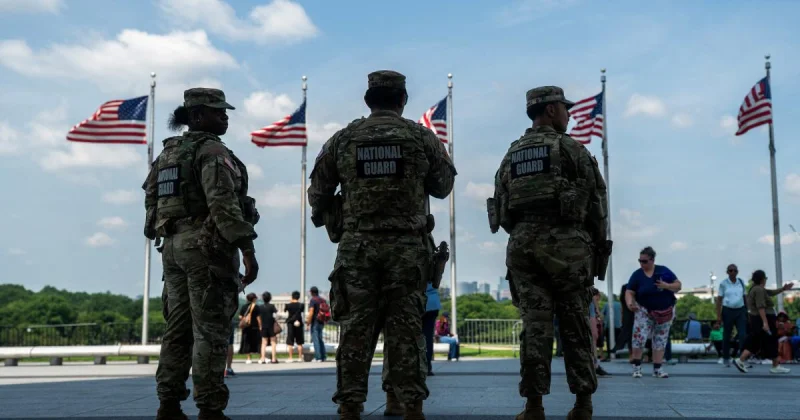
But that same reach is where the problem begins. Using troops for politically contentious domestic missions, including addressing crime in cities, is a much fraught proposition than using them for combat or disaster support. The reason is simple enough: once civilian leaders turn to the armed forces to solve problems that civilian institutions cannot, they risk letting the military become a substitute for repair rather than a tool of last resort.
Foreign Affairs, founded in 1922, has long served as a venue for arguments about American power, but this one is rooted in a narrower claim. A democracy can rely on a strong military without asking it to do everything. Brown, Feaver and Kragie leave the reader with the hard part still open: when civilian institutions are failing, the answer is not automatically more military, and the test is whether leaders can fix the civilian side before they hand the burden to the armed forces.
