


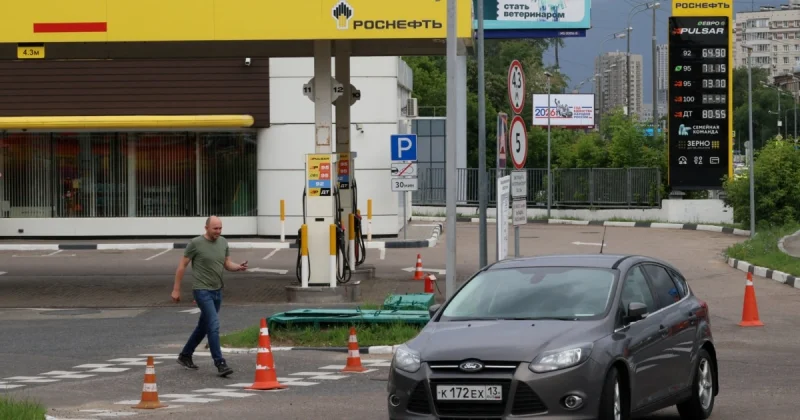
Vladimir Putin publicly acknowledged for the first time that Russia is facing fuel shortages after Ukrainian strikes on energy infrastructure, saying motorists, businesses and even the agricultural industry are still feeling the strain. He said queues remain at petrol stations, some grades of petrol are hard to find, and fuel supply problems are now visible well beyond the front.
Putin’s admission matters because it lands on a day when the Kremlin leader was forced to say out loud what Russia has been trying to downplay: fuel restrictions are spreading, and the disruption is not confined to one corner of the country. Mediazona said 56 Russian regions are now enforcing fuel restrictions, a sign that the pressure from Ukraine's missile and drone strikes on energy infrastructure is reaching deep into the domestic economy.
In remarks to senior officials and oil executives, Putin said, “You’re well aware that problems persist for both motorists and businesses,” and added that “there are still queues at petrol stations.” He said the harvest depended on fuel deliveries arriving on schedule, underlining that the shortages are hitting more than private drivers. He also said Russia was seeing “a certain shortage,” though he insisted it was “not critical.”
The contradiction is hard to miss. Putin acknowledged a shortage, rationing and delays, yet tried to separate those problems from the war itself, saying the strikes had “absolutely no impact on the situation at the front line.” He also said Ukraine was trying to divide Russian society, weaken support for the war and push people toward negotiations, a line that sits uneasily beside his own admission that ordinary fuel supplies are under pressure.
Later, in an interview with Russian state television, Putin said Crimea had only “a few days' supply” left and said he was “confident” more fuel would be brought in soon. He said Russia would increase production of air defences and speed up repairs to refineries that Ukraine managed to hit, a practical response that amounts to an acknowledgement that the attacks are landing with enough force to force repairs, rerouting and tighter supply management.
Crimea carries a special weight in that calculation. Russia occupied the Russian-annexed Ukrainian peninsula of Crimea in 2014, turned it into a military base and a strategic point for controlling the Black Sea, and then used it in 2022 as a launching point for the full-scale invasion of Ukraine. Fuel shortages there are not just an economic problem; they expose a weak point in a region central to Moscow’s war effort and to Putin’s own political narrative.
The immediate question is how long the shortages can last before they force a broader rethink. Putin said repairs would be sped up and more fuel sent in, but he gave no timeline for ending the queues or lifting the restrictions now spreading across Russia. For now, his public admission reads less like reassurance than a warning that the fuel pressure is real, widespread and still building.
