


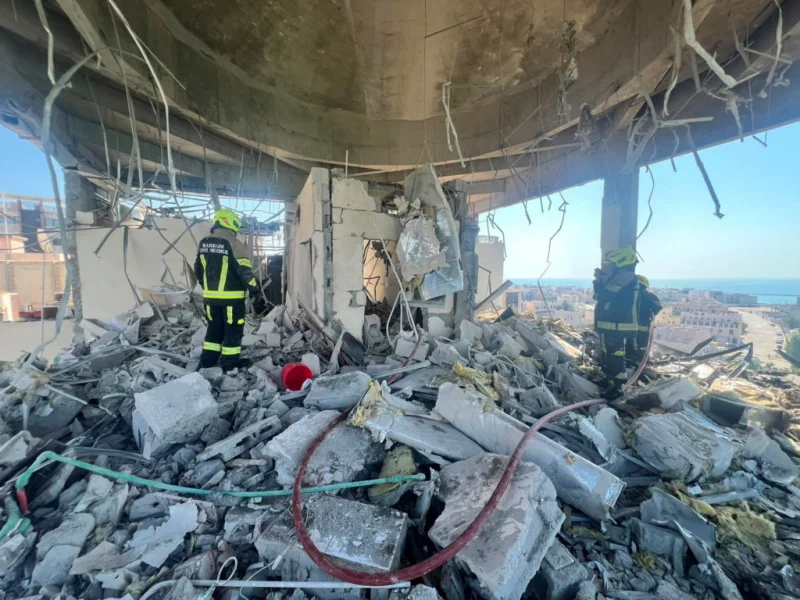
Iran fired drones and missiles at Bahrain and Kuwait on Sunday after new U.S. airstrikes against Iran, widening a conflict that had already been moving through the Persian Gulf by way of shipping threats and retaliatory strikes. Kuwait said its air defenses intercepted Iranian drones and missiles, including two ballistic missiles, while Bahrain said a residential building near the international airport was damaged and no one was killed.
The attacks landed just as the region was already searching for a way to keep commercial traffic moving through the Strait of Hormuz. Bahrain is home to the U.S. Navy's 5th Fleet, which makes the island state a direct point of pressure in any clash around the waterway, and the timing of Sunday's strikes turned that pressure into a live test of how far the fighting could spread.
Iran's paramilitary Revolutionary Guard said it carried out the attacks, and Tehran said they were meant as retaliation for the latest U.S. strikes. The U.S. military's Central Command said it had hit Iranian military surveillance infrastructure, communication systems, air defense sites, drone storage facilities and minelayer capabilities. That exchange left little doubt that both sides were hitting back at each other through targets that sit close to trade routes, airspace and coastal defenses.

Abbas Araghchi sharpened the warning by saying any attempt to create new or separate arrangements from those now being carried out by Iran would delay the reopening of the Strait of Hormuz and increase tension. He was speaking while the United States and Iran have been debating the terms of an interim deal for 60 days, and that deal is supposed to cover shipping arrangements on the strait, the removal of a U.S. blockade on Iranian ports, sanctions on Iran and the future of Iran's stockpile of highly enriched uranium.
That is where the conflict stops looking like a single exchange and starts looking like a contest over the rules of movement itself. In recent days, Iran has twice attacked vessels going through a route on the Omani side in an evacuation effort backed by a United Nations agency, and on Saturday a multinational maritime body overseen by the U.S. Navy said it would expand a route near Oman for inbound and outbound traffic. The moves point to an effort to keep one of the world's most important shipping corridors open even as Iran says alternative arrangements will only make the situation worse.
Bahrain's Foreign Ministry called Sunday's strike a dangerous escalation and said it was not a passing act or an isolated incident, but part of a deliberate approach and a systematic pattern of repeated aggression. With no one killed and Kuwait saying it intercepted the attack, the immediate damage was limited. The bigger question now is whether the 60-day effort to reach an interim deal can survive a day that turned negotiations, shipping and retaliation into the same story.
