


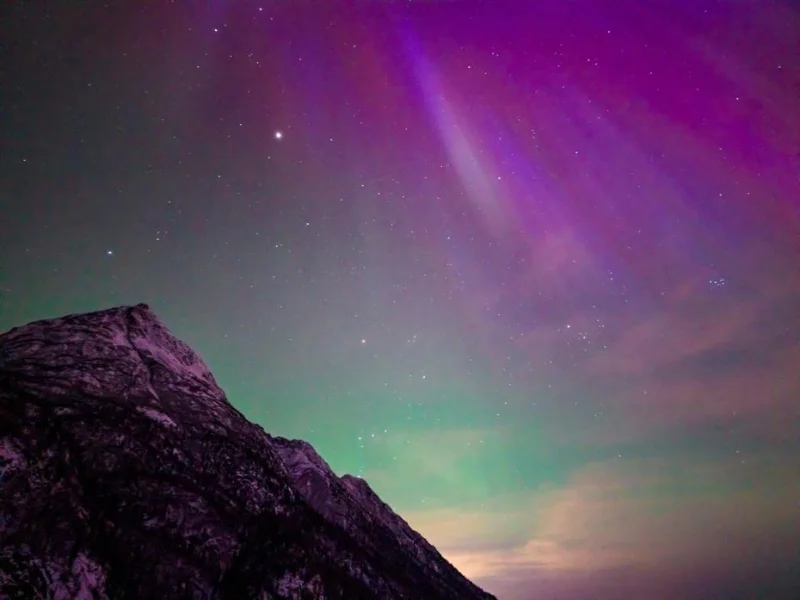
NOAA said the northern lights could be visible Sunday night across several states along the U.S.-Canadian border, giving skywatchers from North Dakota to Washington a possible look at the aurora before a stronger stretch of space weather begins Monday.
The agency forecast a Kp index of five out of nine for Sunday night, a level that can bring the lights farther from the north pole, make them brighter and add more motion and structure. People in North Dakota, much of the Michigan Upper Peninsula, northern Minnesota, northern Montana and the northernmost stretches of Washington, Idaho, Wisconsin and South Dakota could have a chance to see them, while NOAA also said Alaska has a high chance of aurora borealis visibility Sunday night.
That makes Sunday night the first clear viewing window in a forecast that is drawing attention because the timing is tight. A coronal mass ejection escaped from the sun on Saturday and is expected to arrive by Monday, when NOAA expects minor, moderate or even strong geomagnetic storms to begin. Those storms, which NOAA labeled G1 through G3 on its scale, could continue through Tuesday.
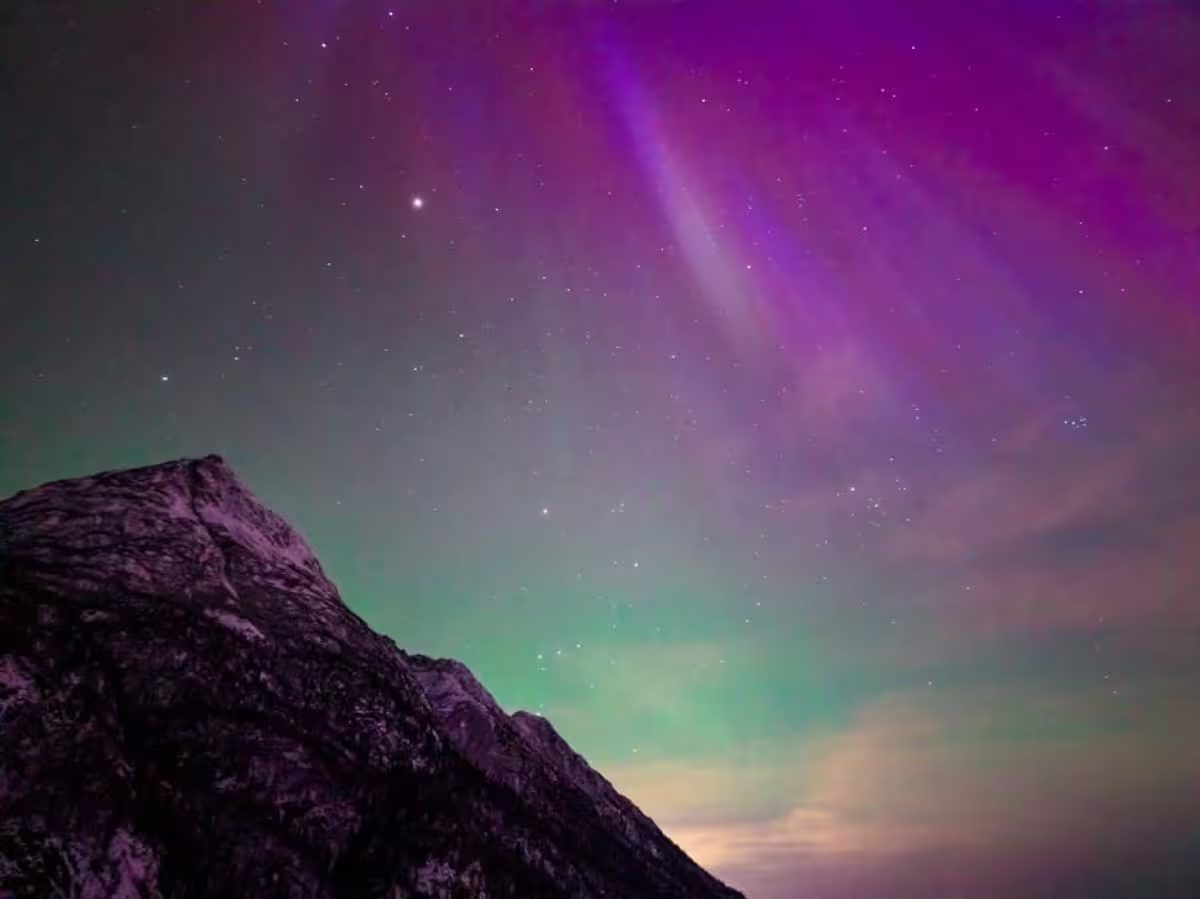
Coronal mass ejections are bursts of solar material from the sun’s outer atmosphere. When they reach Earth, they can interact with the planet’s magnetosphere and trigger geomagnetic storms. Strong storms can push the aurora farther south than usual, even as the Lower 48 still has relatively low chances compared with Alaska.
NOAA said stronger geomagnetic storms can make the aurora visible as far south as Illinois. That does not mean every state in the forecast has the same odds, and the agency did not give a state-by-state certainty for where the lights will actually appear Sunday night. The best viewing remains the northern sky, away from city lights, with experts advising observers to head north if possible and look around midnight, roughly from 10 p.m. to 2 a.m.
For anyone hoping to photograph the display, the advice is simple: turn off flash, use night mode, shoot in RAW if possible and keep the camera steady with a tripod and timed release. The real test comes Monday, when the arriving coronal mass ejection will determine whether the aurora stays a northern treat or briefly spreads farther into the United States.
