


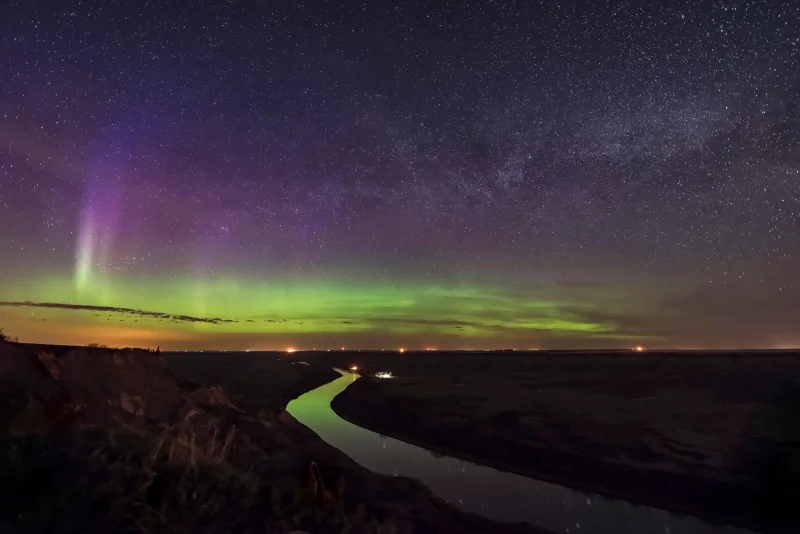
The northern lights could reach far beyond their usual Arctic reach on Thursday night and Friday, as forecasters at NOAA warned that up to G4-strength geomagnetic storms may push auroras into northern U.S. states and Canada.
The timing matters because the strongest activity is expected between Thursday, June 4, and Friday, June 5, when isolated periods of G1 geomagnetic storming are also expected overnight and the sky may briefly light up from multiple solar eruptions arriving together. A G4 storm can send the aurora to many U.S. states, often along the northern horizon, while a G3 or even G4 event could bring the display into mid-latitudes on Friday.
For skywatchers, the list is unusually long. The northern parts of Washington, Idaho, Montana, Wyoming, North Dakota, South Dakota, Minnesota, Wisconsin, Michigan, New York and Maine were among the places with a chance to see the northern lights, along with Oregon, Nebraska, Iowa, Illinois, Indiana, Ohio, Pennsylvania, Massachusetts, Connecticut, Rhode Island, Vermont and New Hampshire. In all, up to 23 states could get a look, with states farther north still holding the best odds.
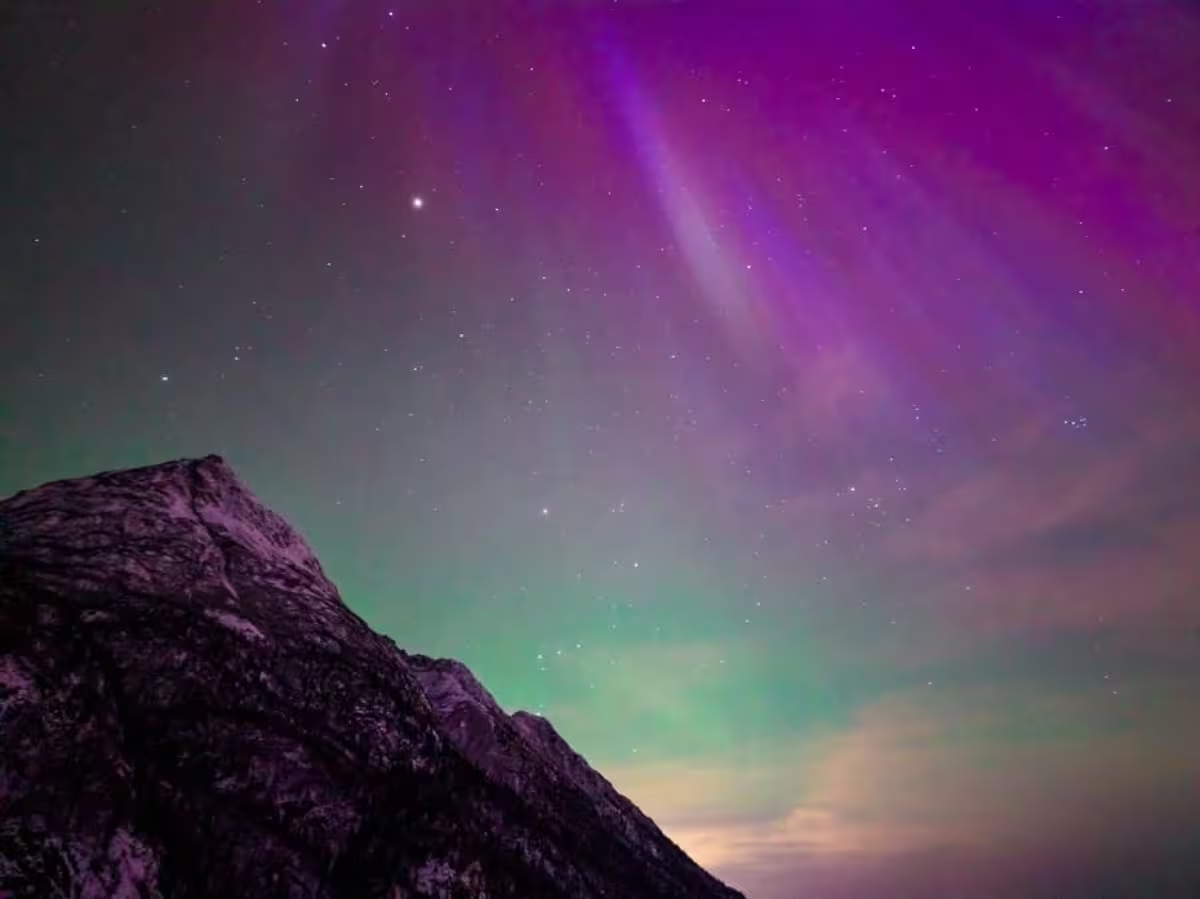
That forecast is built on more than one solar disturbance. Forecasters are watching a possible coronal mass ejection launched from the sun on May 30, a co-rotating interaction region and a high-speed solar wind stream from a hole in the sun’s corona. They are also tracking a series of X-class solar flares on June 3 that were followed by two or even three CMEs, which Spaceweather.com expects to reach Earth on June 5. If those disturbances arrive close together, they can reinforce one another and intensify geomagnetic effects.
There is still a catch. A bright waning gibbous moon will rise after midnight and may brighten the pre-dawn sky, which could make faint aurora harder to spot even if the storm unfolds as predicted. That makes the strongest displays the ones to watch for — the kind bright enough to cut through moonlight and extend well south of the usual viewing line.
Forecasters in the U.K. said geomagnetic activity is expected to increase sharply on June 4, with G1 to G3 storm conditions likely and only a very slight chance of isolated G4 intervals. NOAA’s DSCOVR satellite, positioned about a million miles from Earth, will be one of the key tools used to measure the solar wind speed and magnetic intensity as the disturbances arrive. Because space-weather forecasts can change quickly, the next few hours of satellite data will show whether the pieces line up strongly enough for the northern lights to appear where people are hoping to see them. For live checks, aurora webcams and apps such as Aurora Now, My Aurora Forecast, SpaceWeatherLive and Glendale Aurora have been used to track conditions in real time.
