


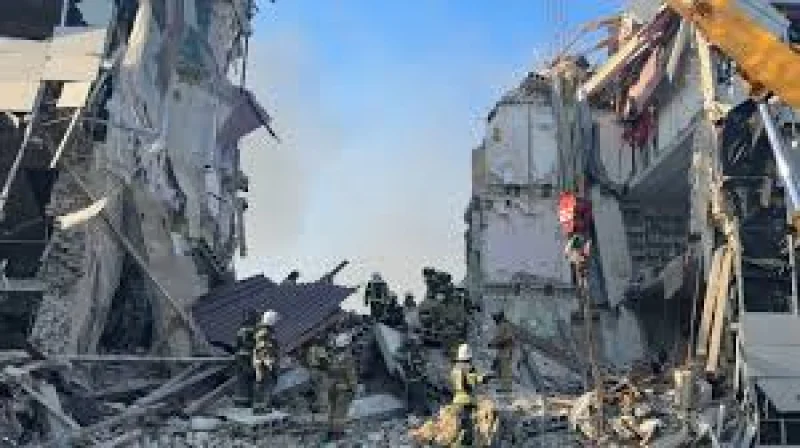
Vladimir Putin blamed Ukraine on Friday for a deadly drone strike on a student dormitory in Starobilsk, in the Russian-controlled Luhansk region of eastern Ukraine, saying six people were killed, dozens more were wounded and 15 were still unaccounted for. He said he had ordered his military to prepare options to retaliate.
Ukraine’s military denied the accusation and said it had struck an elite drone command unit in the area. Hours later, at a UN Security Council emergency meeting called by Russia, Andrii Melnyk dismissed the Russian account as a “pure propaganda show” and said Friday’s operations “exclusively targeted the Russian war machine.” He said the strikes had neutralised an oil refinery, ammunition depots, air defence assets and command centres.
The exchange underscored how the war has become a contest not only of firepower but of narrative, with both sides accusing the other of hitting civilian-linked and military targets as they press their campaign deeper into each other’s rear areas. On Friday, Ukraine’s Defence Ministry said on X that Kyiv had hit 11 Russian oil facilities this month as of 21 May, including the Kirishi site, as it kept up pressure on Russian energy infrastructure.
The fighting also spilled into Russia overnight. Falling debris from drones triggered a fire at an oil terminal in the Black Sea port of Novorossiysk early on Saturday, injuring two people and damaging several technical and administrative buildings, according to officials. The injured men had been in the street when the drones attacked the port. Separately, Ukrainian forces attacked a Russian oil refinery in Yaroslavl on Friday, about 700km from the border.
The energy system damage is now feeding into nuclear concerns as well. The International Atomic Energy Agency said a fire broke out at the Dniprovska 750-kilovolt electrical substation because of military activity, and that an operating nuclear power plant was partially disconnected from off-site power supplies at the request of the grid operator. That leaves another layer of risk on top of the strikes on fuel depots, refineries and ports.
Europe is also feeling the pressure. Czech President Petr Pavel urged Nato to “show its teeth” in response to what he described as Russia’s testing of the alliance’s resolve on its eastern flank, suggesting measures such as cutting off internet access, disconnecting banks from global financial systems and shooting down jets that violate allied airspace. His warning reflected growing concern that the war’s fallout is spilling beyond Ukraine’s borders.
Inside Ukraine, the toll of the war is still being counted in people as much as in damaged infrastructure. More than 90,000 people are listed as missing in the country’s registry, a figure that hangs over every new strike and every claim of retaliation. That makes Friday’s accusations in Luhansk more than a battlefield dispute: it is another reminder that in this war, the next blast can quickly become the next political test, from the front line to NATO’s eastern edge.
