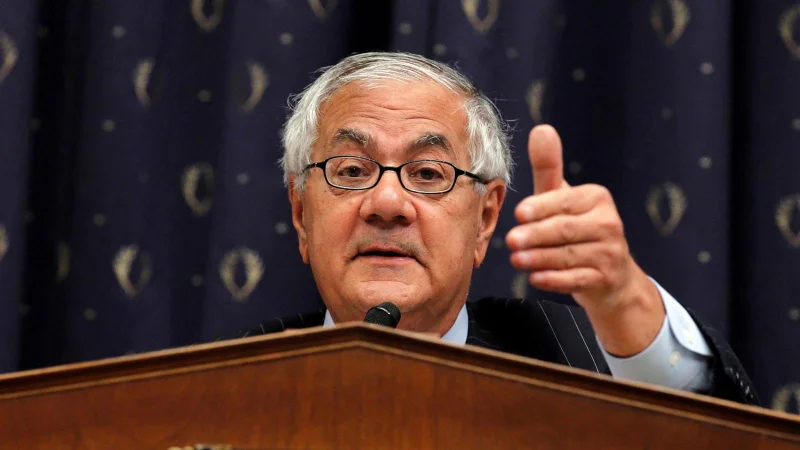
Barney Frank, the former Massachusetts congressman whose blunt liberalism, sharp wit and landmark role in post-crisis financial reform made him one of the most recognizable figures in Washington, has died at 86.
Frank’s death was announced Wednesday, May 20, after a period in hospice care for congestive heart failure. His passing closes the life of a politician who helped shape modern banking law, changed the visibility of LGBTQ+ people in public office and spent more than three decades in Congress arguing that government could be both progressive and practical.
Barney Frank Built A National Profile From Massachusetts
Frank represented Massachusetts in the U.S. House from 1981 until his retirement in 2013, serving a district that included parts of suburban Boston and southeastern Massachusetts. Before Congress, he worked in state politics and served in the Massachusetts House of Representatives, where he developed a reputation as a policy-heavy liberal with little patience for vague answers.
In Washington, he became known as one of the Democratic Party’s most skilled debaters. Frank could be combative, funny and cutting, often turning congressional hearings or television interviews into showcases for his command of detail. Allies viewed him as a legislator who could translate liberal goals into statutory language. Opponents often found him difficult to outmaneuver because he combined ideological clarity with procedural knowledge.
His career was not built on a polished public image. Frank’s appeal rested partly on the opposite: he was openly impatient, frequently sarcastic and rarely interested in smoothing the edges of his arguments. That style made him a singular presence in Congress, especially during an era when cable news increasingly rewarded confrontation.
Dodd-Frank Became His Defining Legislative Legacy
Frank’s most consequential policy role came after the 2008 financial crisis, when he chaired the House Financial Services Committee. The collapse of major financial institutions, the housing crash and the federal bailout of Wall Street put him at the center of one of the most urgent economic debates in modern U.S. politics.
The result was the 2010 Dodd-Frank Act, the sweeping financial regulation law that bears his name alongside former Sen. Chris Dodd. The law tightened oversight of banks, created new rules for derivatives, expanded federal authority over systemically important financial firms and established the Consumer Financial Protection Bureau.
Supporters viewed the law as a necessary response to reckless risk-taking and regulatory failure. Critics argued it burdened banks and did not fully address deeper housing and credit-market problems. Frank defended the measure as a pragmatic attempt to reduce the chance that financial institutions could again take extraordinary risks while leaving taxpayers to absorb the consequences.
Even after he left Congress, Dodd-Frank remained politically contested. Republican lawmakers and bank lobbyists pushed for rollbacks, while consumer advocates warned against weakening safeguards created after the crisis. Frank’s name stayed attached to that fight long after his retirement.

A Trailblazer For LGBTQ+ Representation
Frank also made history in 1987 when he became the first sitting member of Congress to voluntarily come out as gay. At the time, open LGBTQ+ representation in national politics was rare, and the political risks were significant.
His decision changed both his career and the broader landscape of American politics. Frank became a visible advocate for gay rights, AIDS funding, anti-discrimination protections and marriage equality while continuing to work on housing, banking and civil liberties issues. He resisted being defined only by his sexuality, but he also understood the importance of being openly present in an institution where LGBTQ+ people had long been invisible or pushed to the margins.
In 2012, Frank became the first sitting member of Congress to marry a same-sex partner, Jim Ready. The marriage came just months before his retirement and three years before the Supreme Court recognized same-sex marriage nationwide.
Controversy Followed Him, But Did Not End His Career
Frank’s public life also included serious controversy. In 1989, the House reprimanded him after an ethics investigation tied to his relationship with a male sex worker. The episode created one of the most difficult periods of his career and exposed him to political attacks that mixed ethics questions with anti-gay prejudice.
He survived politically and continued winning reelection by wide margins. That durability reflected both the partisan makeup of his district and the loyalty he built among voters who saw him as an unusually effective representative. The controversy remained part of his record, but it did not prevent him from rising to one of the most powerful committee posts in Congress.
Frank’s later years in office showed the same mixture of vulnerability and force that had defined him earlier. He remained a fierce defender of liberal government, but he also warned Democrats against slogans and positions he believed could alienate persuadable voters.
His Final Warnings Reflected A Lifelong Political Instinct
In his final weeks, Frank continued speaking about politics from hospice care. He warned that Democrats risked losing voters if they allowed the party to be defined by positions he considered too far outside the mainstream, including on policing, immigration and some cultural issues.
Those comments fit a long-standing pattern. Frank was a liberal, but not a sentimental one. He believed in using government power to protect people from discrimination, economic abuse and concentrated private power. He also believed winning elections required discipline, coalition-building and attention to voters who did not already agree with the left.
That combination made him difficult to categorize neatly. He was a progressive landmark figure and a political realist, a gay rights pioneer and a budget negotiator, a Wall Street critic who understood financial plumbing better than many of his adversaries.
Frank is survived by his husband, Jim Ready, and members of his family. His death leaves behind a legacy measured not only in one landmark law, but in the visibility he created, the arguments he sharpened and the model he offered of a public official who refused to separate personal candor from political power.