


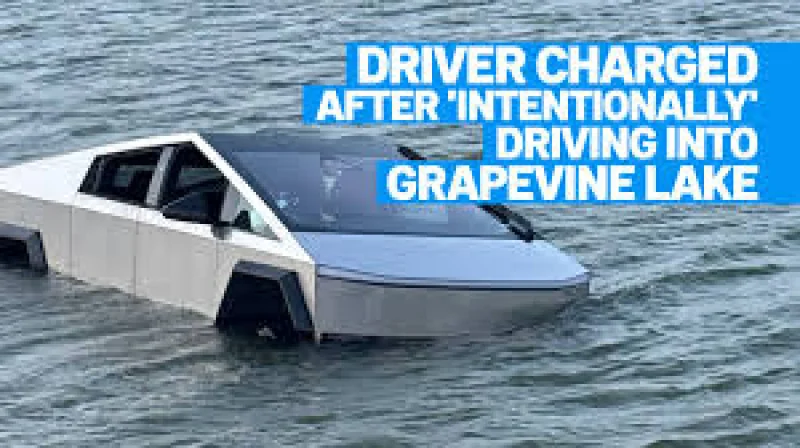
A man was arrested in Texas after police say he intentionally drove a Tesla Cybertruck into a lake to test the vehicle's “wade mode” feature. A witness captured the partially submerged truck near the shoreline on the south side of the lake.
Police later worked with the Grapevine Fire Department Water Rescue Team to remove the vehicle from the waterline, where it had come to rest near shore. The scene turned a feature meant for shallow crossings into a rescue and recovery operation.

The reason given for the alleged act is unusual even by roadside standards: the Cybertruck's “wade mode” was the stated motivation, according to the source. The man was not identified by name, and the exact date of the incident was not provided. But the sequence is clear enough. A single test drive became a law enforcement matter, with a witness video, a submerged vehicle and a recovery effort that needed fire crews and police working together.
That matters because the episode is less about a vehicle feature than the moment someone decided to push it into a lake and see what happened. It also puts the focus on how far drivers may go to probe new technology when the result can leave responders pulling a 1 Tesla Cybertruck from the water instead of a road.
The case follows the same pattern seen in other public safety and product-scrutiny stories: one person's test becomes everyone else's problem. In the same way readers might follow a Tirage Au Sort Roland Garros update or a Smiles At Rittenhouse Square probe for what happens next, the details here are all about the outcome, not the novelty. The vehicle was removed, the arrest was made, and the unanswered question is not whether the truck can wade, but why anyone would use a lake to find out.
