


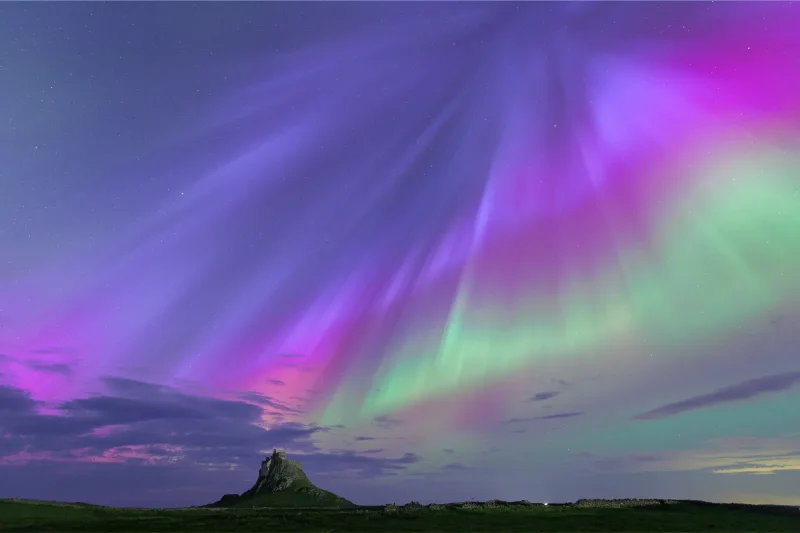
Space-weather forecasters are monitoring renewed solar activity that could raise the chance of geomagnetic storm conditions and northern lights over the next several days, with attention focused on active sunspot regions rotating into a more Earth-facing position. No extreme storm warning was in effect Thursday, May 21, but the setup has kept aurora watchers, satellite operators and power-grid monitors alert after several recent bursts of solar activity.
What A Geomagnetic Storm Means
A geomagnetic storm happens when energy from the sun disturbs Earth’s magnetic field. The most common trigger is a coronal mass ejection, or CME, a large burst of magnetized plasma that leaves the sun and can reach Earth in one to several days. High-speed solar wind streams from coronal holes can also drive stormy conditions.
The intensity is measured on a G-scale from G1 to G5. A G1 storm is minor and can bring auroras farther south than usual with limited technical effects. A G5 storm is extreme and can cause widespread disruption to satellites, radio communications, navigation systems and power infrastructure.
Most events that draw public attention are in the G1 to G3 range. They can still produce vivid auroras, especially across Canada, Alaska, the northern United States, Scotland, Scandinavia, New Zealand and southern Australia, depending on timing, weather and local darkness.
Why Forecasters Are Watching The Sun Now
The latest concern comes from solar activity observed over recent days, including active regions that produced multiple flares while rotating toward the side of the sun visible from Earth. That rotation matters because eruptions launched from the Earth-facing side have a better chance of sending charged material toward the planet.
A flare alone does not guarantee a geomagnetic storm. Flares are bursts of radiation that can cause short-lived radio blackouts on the sunlit side of Earth. A stronger aurora event usually requires a CME with enough speed, density and magnetic alignment to interact with Earth’s magnetosphere.
The hardest part of forecasting is the magnetic orientation of the incoming solar material. A CME with a southward magnetic field can connect more efficiently with Earth’s magnetic field and intensify a storm. That detail often cannot be measured with confidence until the solar wind reaches monitoring spacecraft upstream from Earth.
Northern Lights Could Be Possible In Higher Latitudes
If storm conditions develop, the most likely public effect would be increased aurora visibility. Northern lights are usually strongest closer to the poles, but stronger storms can push the auroral oval toward lower latitudes.
In North America, that can bring sightings into parts of the northern United States, especially states near the Canadian border. In Europe, Scotland and northern England may have better chances during stronger activity. In the Southern Hemisphere, Tasmania, southern New Zealand and parts of southern Australia are often favored when conditions intensify.

The best viewing window is usually between 10 p.m. and 2 a.m. local time, away from city lights and with a clear northern horizon in the Northern Hemisphere. Cameras can sometimes detect color before the naked eye does, especially during weaker displays.
Technology Risks Are Usually Limited In Minor Storms
A minor or moderate geomagnetic storm is not dangerous to people on the ground. The atmosphere and magnetic field shield the public from direct solar radiation linked to these events.
The operational risks are more technical. Geomagnetic storms can increase drag on satellites in low Earth orbit, affect high-frequency radio communication, degrade GPS accuracy and create extra current in long power lines. Airlines, satellite companies, grid operators and emergency managers monitor space-weather alerts for that reason.
Severe events are rarer but more consequential. The strongest storms can disrupt communications, force satellite operators to make protective adjustments and complicate navigation. The 2024 and 2025 solar-maximum period brought several major aurora events, reminding agencies that the modern economy is more exposed to space weather because it relies heavily on satellites and precision timing.
The Sun Is Still In An Active Cycle
The current period is tied to Solar Cycle 25, the roughly 11-year cycle in which the sun moves from quieter conditions to solar maximum and back again. Around solar maximum, sunspots, solar flares and CMEs become more common.
That does not mean every active region will produce a damaging storm. Many eruptions miss Earth entirely, and some glancing blows produce only brief or minor disturbances. Still, active regions facing Earth deserve attention because a single well-positioned CME can rapidly change the forecast.
For aurora watchers, that creates a familiar pattern: forecasts may look modest until a new eruption occurs, then viewing prospects can improve within a day or two. For infrastructure operators, the same uncertainty means preparation depends on continuous monitoring rather than one fixed forecast.
What To Watch Next
The key indicators over the next 24 to 48 hours will be new Earth-directed eruptions, changes in solar wind speed and density, and the real-time direction of the interplanetary magnetic field as any solar material approaches.
For the public, the practical advice is straightforward: check the latest space-weather and cloud-cover conditions before traveling for aurora viewing, use dark-sky locations when possible and remember that auroras can surge or fade quickly.
The developing solar setup does not point to an emergency by itself, but it keeps geomagnetic storm chances in focus. If a stronger eruption leaves the sun while facing Earth, forecasts could shift quickly from routine space-weather monitoring to a broader aurora and technology-impact alert.
