


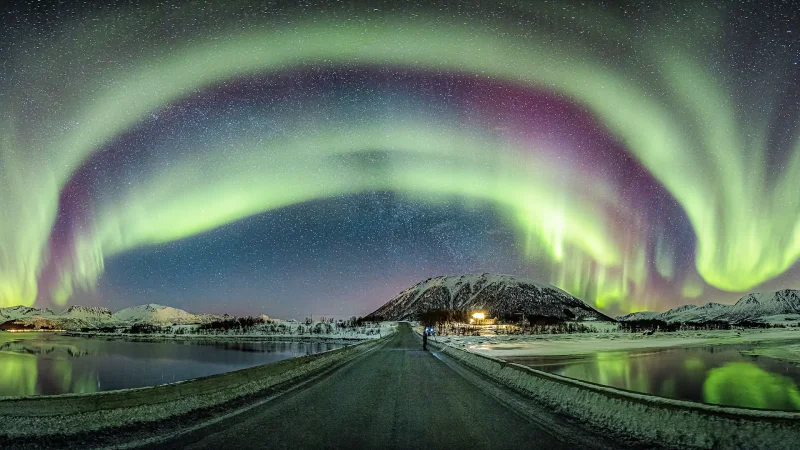
A weekend burst of solar activity kept northern lights watchers across North America on alert, with a G1 geomagnetic storm forecast extending aurora chances into Monday, May 18, after fast solar wind and a glancing coronal mass ejection disturbed Earth’s magnetic field.
Aurora Watch Continues After Weekend Activity
The aurora borealis became a major skywatching story over the weekend after geomagnetic conditions reached storm levels and expanded viewing chances across Canada, Alaska and parts of the northern United States.
The strongest activity was tied to G1 and brief G2 geomagnetic conditions, enough to raise the possibility of aurora visibility beyond the usual far-northern zones. In practical terms, that meant rural viewers in northern states had a better chance of seeing a glow low on the horizon, while parts of Canada and Alaska had stronger odds for brighter displays.
By Monday, the forecast had shifted toward a more modest but still meaningful setup. A G1 storm is the lowest level on the five-step geomagnetic storm scale, but it can still produce visible northern lights at high latitudes when skies are dark and clear.
Solar Flare And CME Drive The Forecast
The latest aurora forecast is linked to solar activity that sent charged material into space after a solar flare and related coronal mass ejection. A solar flare is a burst of radiation from the sun, while a coronal mass ejection is a cloud of magnetized plasma that can disturb Earth’s magnetic field if it reaches the planet.
In this case, the most likely scenario is a glancing impact rather than a direct hit. That distinction matters. A direct, well-aligned CME can produce stronger geomagnetic storms and push auroras farther south. A glancing blow is usually less intense, but it can still energize the upper atmosphere enough to create visible displays in northern regions.
Fast solar wind from a coronal hole also contributed to the weekend activity. When that stream interacts with Earth’s magnetic field, it can keep aurora chances elevated even when a CME is not especially strong.
Where Northern Lights May Be Visible
The best viewing odds remain across Alaska, much of Canada and the northern tier of the United States. For the Lower 48, the most realistic viewing areas include parts of Washington, Idaho, Montana, North Dakota, South Dakota, Minnesota, Wisconsin, Michigan, northern New York and Maine.
A G1 storm does not usually bring bright overhead auroras deep into the United States. More often, people at lower latitudes may see a faint green, red or purplish glow near the northern horizon. Cameras can sometimes capture color that is difficult for the eye to see in real time.

Visibility will depend heavily on local conditions. Cloud cover, city lights, wildfire smoke, haze and the timing of geomagnetic activity can all decide whether a forecast turns into a visible show. A rural location with a clear northern view offers the best chance.
What A G1 Geomagnetic Storm Means
A G1 geomagnetic storm is considered minor. It is not a public safety threat, and most people will experience it only as a potential aurora event. Still, even minor storms can produce limited effects on satellites, radio communication and power-grid management at high latitudes.
For skywatchers, the more important number is the Kp index, which measures global geomagnetic activity. A Kp level near 5 corresponds to G1 storm conditions, while stronger values can move auroras farther from the poles.
The weekend’s brief G2 activity improved viewing prospects for more northern U.S. states. Monday’s expected G1 conditions suggest a more restrained aurora forecast unless the incoming solar wind arrives with a favorable magnetic orientation.
Best Time To Watch The Northern Lights
The best viewing window is after full darkness and before dawn, with the hours around local midnight often offering the strongest opportunity. The aurora can appear suddenly, fade quickly and return later, so a short glance outside may not be enough.
Viewers should face north, avoid streetlights and give their eyes time to adjust. A phone camera in night mode, held steady against a tripod, fence post or vehicle roof, can help detect faint aurora before it becomes obvious to the naked eye.
The forecast is especially time-sensitive because solar wind conditions can change within minutes. A night with good potential can still disappoint if the strongest activity arrives before darkness or after sunrise in a particular region.
Solar Activity Keeps The Aurora Outlook Active
The broader reason for repeated northern lights alerts is the sun’s active phase in its 11-year cycle. More sunspots, flares, coronal holes and CMEs increase the odds of geomagnetic storms, though not every eruption is aimed at Earth or strong enough to create a visible display.
For North America, the immediate watch centers on Monday night into early Tuesday. The most likely outcome is a modest high-latitude aurora event, but a brighter display remains possible if the solar wind’s magnetic field connects efficiently with Earth’s magnetosphere.
The weekend already showed how quickly conditions can change. For now, the northern lights forecast favors patience, dark skies and northern locations rather than a guaranteed widespread show.
