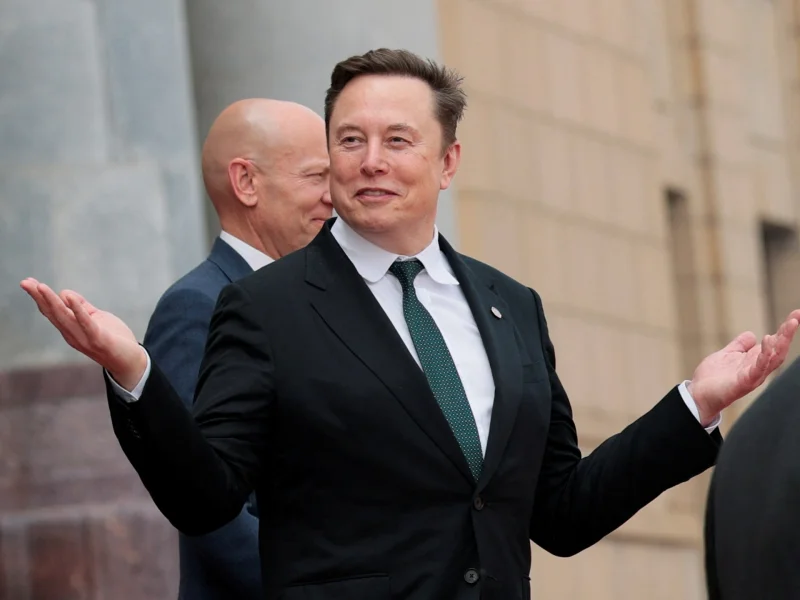
President Donald Trump brought more than a dozen U.S. business leaders with him to Beijing on Wednesday as he met Chinese President Xi Jinping for talks on trade, technology and artificial intelligence. The group included Elon Musk, Apple chief Tim Cook and Goldman Sachs chief David Solomon, in a rare show of corporate firepower on a state visit that blended diplomacy with dealmaking.
Trump introduced the executives to Xi as “distinguished representatives from the American business community” who “all respect and value China.” The business leaders told Xi they highly value the Chinese market and hope to do more business there. Xi responded that he welcomed more “mutually beneficial cooperation” and said American companies will have “broader prospects in China.”
Musk traveled to China on Air Force One with Trump. He told reporters he wants to accomplish “many good things” while in China. Nvidia chief Jensen Huang joined the plane at a stopover in Alaska and later said a meeting with Chinese officials had gone “excellently.” Also on the trip were BlackRock Chairman and CEO Larry Fink, Citi Chairman and CEO Jane Fraser, Blackstone CEO and cofounder Stephen Schwarzman and Boeing CEO and President Kelly Ortberg.
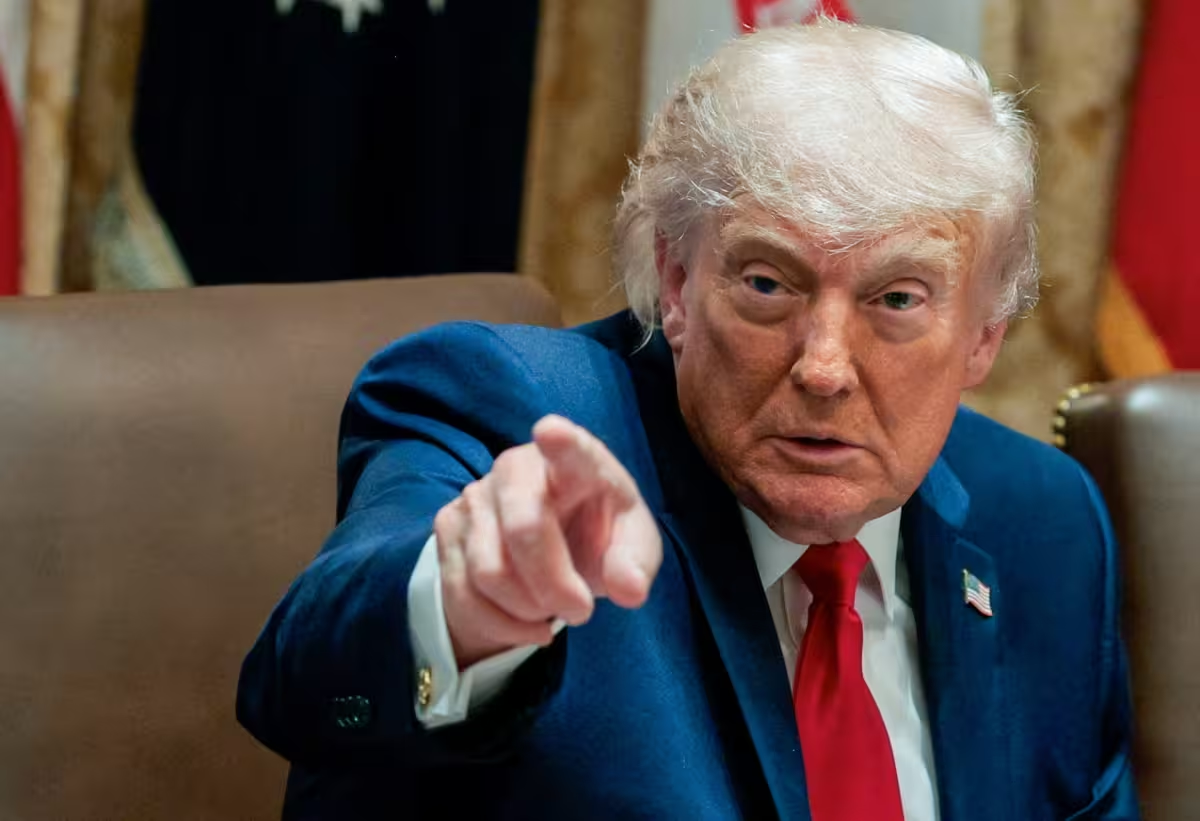
Other companies represented on the state visit to Beijing included Meta, Cargill, Visa, Cisco, Qualcomm, Coherent, Micron, GE Aerospace, Illumina and Mastercard. The roster underscored how deeply many top U.S. firms are tied to China, both as a market and as a manufacturing base, even as tensions between the two countries remain high.
Trump and Xi were set to discuss extending a one-year truce on tariffs and on exports of Chinese rare earth metals. Trump’s sweeping tariffs last year triggered tit-for-tat levies that exceeded 100 percent, and China later restricted exports of seven of 12 specific rare earths in April last year before saying later in 2024 that it was planning to restrict five more. China controls the majority of global mining and processing of critical rare earth metals, giving those talks extra weight for companies that depend on those materials and the trade flows around them.
The presence of so many executives in Beijing showed where the pressure points still are: the world’s biggest economy, the world’s second-biggest economy and the companies caught between them. The next test is whether the Trump-Xi truce survives long enough to keep trade, technology and supply chains from sliding back into a new round of retaliation.