


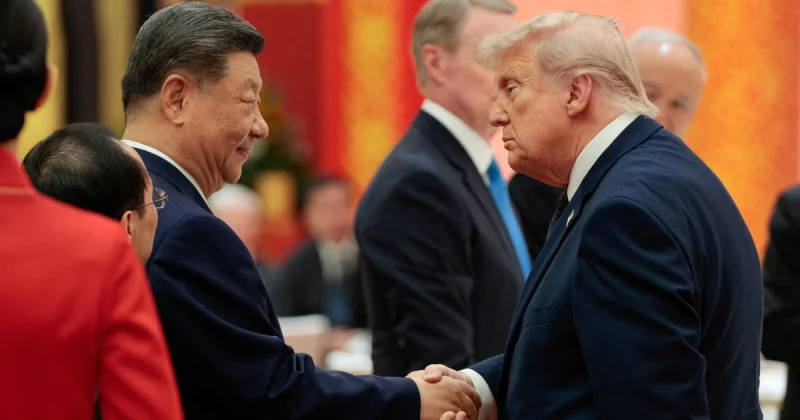
President Donald Trump raised the Strait of Hormuz and the war on Iran during his meeting with Xi Jinping on Thursday, putting the world’s most important energy chokepoint at the center of a discussion with China’s leader. The White House said the two agreed the strait must remain open to support the free flow of energy.
Trump said Xi made clear Beijing would not provide military equipment to Iran, calling that “a big statement.” He also said China wants the waterway to stay open because it buys large amounts of oil from the region. “When you say ‘support’, they’re not fighting a war with us or anything,” Trump said.
The White House said Xi also made clear China’s opposition to the militarisation of the strait and any effort to charge a toll for its use. Treasury Secretary Scott Bessent said he believed Beijing would “do what they can” and described the waterway as “very much in their interest.” The Chinese Foreign Ministry’s public readout of the talks made no mention of Iran or the Strait of Hormuz.
The exchange came as shipping around the strait remained unsettled. Iran has let some carriers sail through the key waterway under special agreements, and a Chinese tanker transited through it on Wednesday, according to shipping data seen by. Iran’s Fars News Agency reported on Thursday that there was an agreement to allow some Chinese ships to pass, while state broadcaster IRIB said about 30 vessels had transited since Wednesday evening.
The US said on Thursday it had so far redirected 70 vessels and disabled 4 others to enforce Trump’s blockade on ships traveling to or from Iranian ports through the Strait of Hormuz. At the same time, a ship anchored off the United Arab Emirates was seized and taken toward Iran, and another was attacked and sank. The United Kingdom Maritime Trade Operations said unauthorized personnel had taken over a vessel anchored off the UAE port of Fujairah on Thursday and it was heading toward Iran.
On Wednesday, an Indian-flagged wooden cargo vessel sank in Omani waters after a fire from a suspected drone or missile strike. India’s shipping ministry said the vessel was sailing to the UAE from Somalia, and the Omani coast guard rescued all 14 crew members.
The strait sits at the center of global energy flows, and disruptions in and around it have already pushed fuel prices higher. Since the conflict began at the end of February, Iran has all but closed the route, making every sign of transit and every exception to the blockade carry outsized weight. The next test is whether the pressure on shipping eases for good, or whether the lanes remain open only for the vessels Tehran and Beijing choose to spare.
