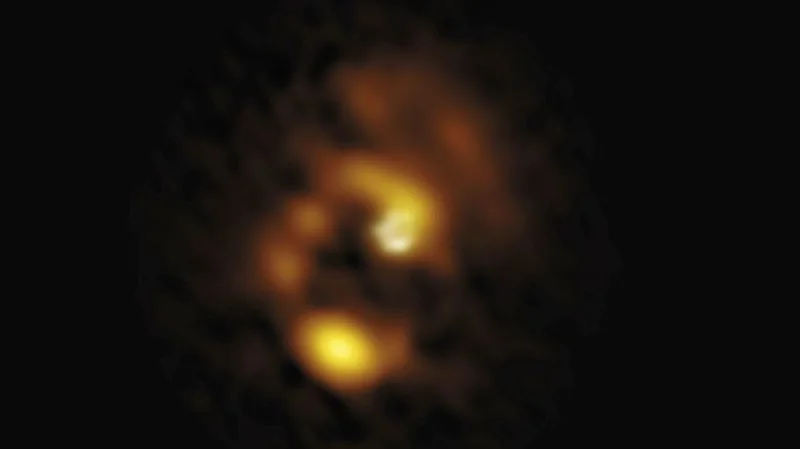
A new study of Mira A has found evidence that a giant magnetic eruption may be helping drive the star’s mass loss, not just the dust-driven winds astronomers have long blamed. Using ALMA observations, researchers concluded that magnetic fields around the red giant can shape and power its outflow.
The finding matters because Mira is not just any aging star. It is the prototype of Mira variables, a class of oxygen-rich pulsating AGB stars, and the new work on the Mira star red giant eruption ALMA has put into question a model that has dominated for decades.
The research, published in Astronomy and Astrophysics, was led by Wouter Vlemmings, a professor in the department of Physics and Astronomy at Chalmers University of Technology in Gothenburg, Sweden. He said strong magnetic fields can also shape and power stellar winds, and that this changes a fundamental part of the origin story of the atoms we ourselves are made of.
The team studied Mira with the Atacama Large Millimeter/submillimeter Array, which cannot see magnetic fields directly. Instead, it picks up the polarizing effect those fields have on radio emissions, allowing researchers to infer where magnetism is influencing the star’s surroundings. In this case, that indirect signal pointed to a magnetic field structure strong enough to matter for the star’s mass loss.

That is where the result cuts against the old picture. For decades, astronomers have said winds from stars like Mira are driven by starlight pushing grains of dust in the outer atmosphere. The authors of the study say mass loss in the advanced stages of low- and intermediate-mass stars is traditionally attributed to dust-driven winds, while the role of magnetic fields has remained poorly constrained.
Vlemmings and his colleagues are not dismissing dust. They are saying it may not be the whole story. Astrophysicists have already detected strong magnetic fields in the circumstellar envelopes of AGB stars like Mira, and researchers have suggested such fields may help drive mass loss. What has been missing, the team writes, is empirical evidence for that role. Their ALMA data are intended to provide it.
The scale of the process helps explain why this matters. AGB stars can shed as much as 30 Earth masses of material per year into the interstellar medium. That material first leaves in pulses of gas, then cools into dust, and then radiation pressure can push it farther out with the stellar wind. The authors say that mass loss during this stage is crucial for the chemical enrichment of the Universe.
That enrichment is not abstract. Carbon and silica are part of what AGB stars release, with silica forming a main building block for rocky planets and carbon feeding organic particles. If magnetic fields are helping shape Mira’s wind, then the mix of forces that seed the interstellar medium is more complicated than the standard story of dust and light alone.
What the study does not yet settle is how much of Mira’s outflow is magnetic and how much remains dust-driven. It shows that the field can leave a mark on the wind; it does not yet measure how large that mark is. That is the next question now hanging over Mira, and over the stars that help build the raw material for planets, rocks and life.