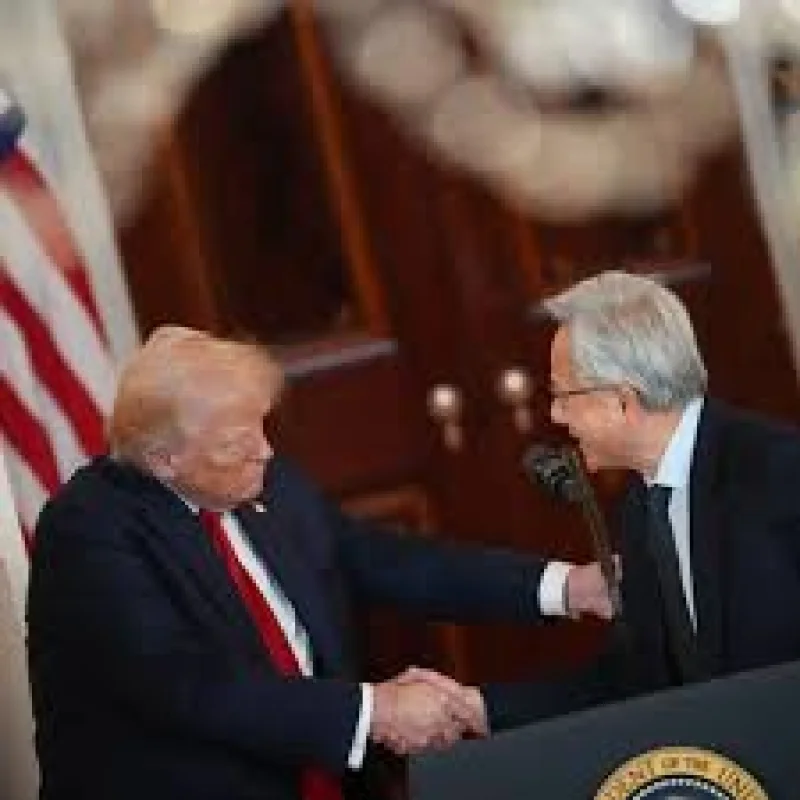
President Trump said Monday he personally spoke with Nvidia's board and convinced it to bring Jensen Huang back, a move that sent Nvidia shares up more than 30% when Huang returned to the company on Monday. The president said he gave the board an assurance that there was no national security threat.
The trade was not abstract for Trump. He held between $13 million and $58 million in Nvidia stock in his investment accounts as of the end of 2025, and his shares gained as much as $14.8 million on Monday before some of those gains were pared back Tuesday when Nvidia's share price ticked down. Across January 2025 through September 2026, Trump bought or sold Nvidia stock in more than 100 transactions worth between $27 million and nearly $98 million.
Huang had resigned two weeks earlier after reports of an affair with a suspected Chinese spy who ran a company accused of diverting Nvidia chips to China, along with another alleged affair with a subordinate. Nvidia is one of the world's most valuable public companies, worth more than $3.7 trillion, so even a short-lived jump in its stock can move a large portfolio quickly. Forbes estimates Trump's net worth at more than $6 billion.

The White House said Trump's stock and bond portfolio is independently managed by third-party financial institutions, and that neither he nor any member of his family can direct, influence or provide input on how it is invested or when trades are made. But the explanation has done little to quiet the conflict questions, especially because several of Trump's appointees in the State, Commerce and Treasury departments as well as the IRS reported millions in Nvidia stock in their own portfolios, and many of them have since sold those holdings.
Kathleen Clark said, “This goes beyond a conflict of interest.” She said Trump was “squarely, explicitly using his power as president to benefit himself financially” and that he had “prioritized his finances over the security of the nation.” Donald Sherman was blunter still, saying Trump's continued ownership of stock in the company is “the clearest example of how the president's personal financial interest makes everything he does suspect.”
What remains unclear is what, exactly, changed inside Nvidia before Huang was restored. Trump has said he spoke with the board and secured the reversal, but the company has not spelled out the specific board action or internal process that led to the decision. That leaves the political question hanging over the market reaction: whether the president was simply commenting on a corporate call, or using the office to shape an outcome that moved a stock he owned.