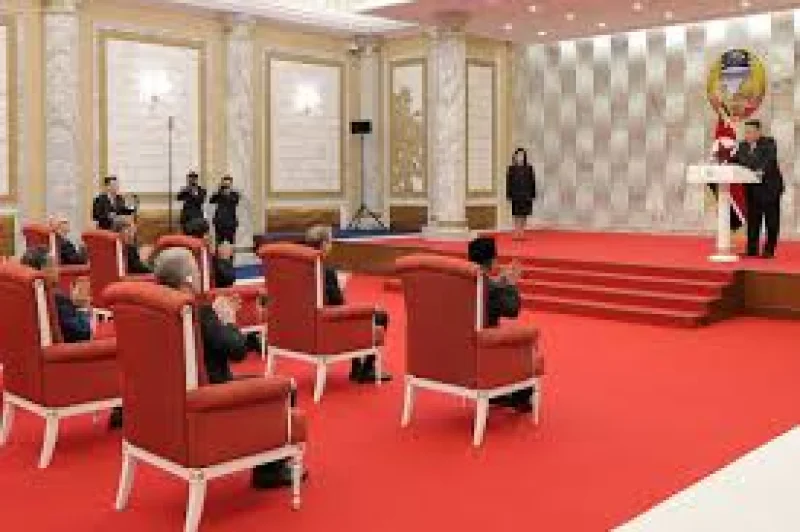
Kim Jong Un met 10 newly appointed ambassadors on Nov. 22, 2026, in a rare credential ceremony that paired diplomacy with a blunt defense of North Korea’s military buildup. He told the envoys that Pyongyang is not seeking regional dominance and is pursuing neither supremacy nor expansion.
The ambassadors came from Russia, Sweden, Indonesia, Vietnam, Brazil, the Czech Republic, India, the Philippines, Thailand and Bangladesh, and Kim used the occasion to cast North Korea’s armed posture as a sovereign right. He said the country will firmly defend its national sovereignty, security interests and development rights to cope on its initiative with what he called an ever-changing critical international situation.

The timing made the message hard to miss. The ceremony came after North Korea carried out a series of missile tests in the weeks leading up to the meeting, and after the International Atomic Energy Agency said the North had expanded a uranium enrichment facility at its main nuclear complex.
Rafael Grossi told the agency’s board of governors on Wednesday that construction on another addition to the enrichment facility at Yongbyon began in mid-September and that the exterior was completed by late October. That leaves Kim’s diplomatic language at odds with the military picture unfolding around him: a leader talking about peace, development and prosperity while his country pushes ahead with weapons work and hardens its border with additional mines and barbed-wire fences.
Kim also said North Korea is willing to strengthen ties with countries that respect its independence and interests, which is the clearest clue to what this ceremony may mean. It points to a message of controlled openness rather than a change in direction, and for now there is no sign that the handshakes will produce a new diplomatic opening beyond the formal reception itself.