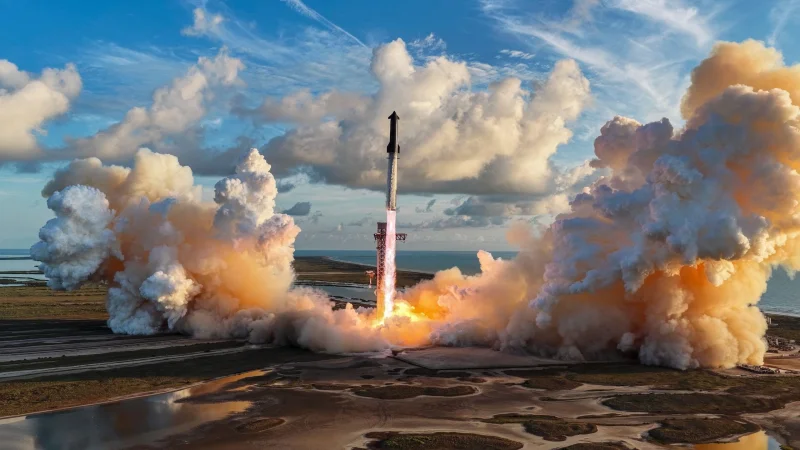
SpaceX is set to try something it has never done before on Friday: catch both stages of Starship Flight 15 with the arms of its launch tower in Starbase, Texas. The launch is planned to begin sometime after 5:45 p.m. ET, and the booster is expected back at the pad about 6.5 minutes after liftoff for the first catch attempt.
That timing is why the SpaceX launch is drawing so much attention now. A clean dual catch would mark a major step toward full reusability, and Morgan Stanley analyst Adam Jonas has said a successful Starship catch could be “the biggest positive catalyst since the IPO” for the company. SpaceX reported $14.6 billion in overall sales in its latest quarter, including $1.8 billion from its launch business, so investors are watching closely to see whether the test changes the story around the company’s pace of development.
The plan is not a short hop. Starship is set to circle Earth 14 times over more than 22 hours while deploying 26 Starlink V3 satellites, then come back on Saturday for its own catch attempt after reentry. That mission profile is built to push the vehicle through a full orbital flight, a deployment phase and a return through the atmosphere, all in one run, rather than stopping after a brief proof of concept.

There is still a clear risk in the middle of the plan. SpaceX has successfully caught the Super Heavy booster three times before, but it has never caught Starship, and if anything looks off the company can abort and divert the ship to the ocean. The caution matters because Flight 14, which reached orbit for the first time in September, was cut from a planned 10-hour mission to about three hours after an engine problem. Before that, two boosters ended in hard landings, even though Flight 14’s booster did splash down in the ocean.
That is why Friday is more than another launch window. Elon Musk said on the company’s October earnings call that success was “more likely than not,” and SpaceX is acting as if the next few hours could tell Wall Street a lot about how fast it can move from one-off orbital flights to routine recovery. If the catches work, the company would not just be proving a system that can fly; it would be showing it can come back, be caught and be used again.
The unanswered question now is not whether SpaceX can get Starship off the ground. It is whether the upper stage can survive reentry and make the catch on Saturday after the booster has already tried to come home first.